How Does Private Label Work? Quick Answer: Starting eBay private label from scratch involves ten core steps: setting up a business seller account, researching and validating product demand using real sales data, finding and qualifying a manufacturer or supplier, creating a simple but coherent brand identity, building an optimised eBay listing with accurate item specifics, photographing the product correctly, pricing competitively after accounting for all fees, fulfilling orders reliably to build feedback, and scaling once the first listing proves it works. eBay private label requires less capital than Amazon, has a more forgiving algorithm for new sellers, and rewards listing accuracy and seller reputation over brand recognition.
Why eBay Is a Legitimate Starting Point — Not a Fallback
Most guides about starting private label begin with Amazon. That’s understandable — Amazon gets most of the attention, most of the course content, and most of the seller community discussion. But framing eBay as the alternative you turn to when Amazon doesn’t work misrepresents what eBay actually offers.
eBay has over 132 million active buyers globally. It processes billions in gross merchandise volume annually. In specific categories — automotive parts and accessories in particular — it outperforms Amazon in both traffic volume and conversion. The competitive landscape for private label on eBay is materially less saturated than Amazon’s because the collective attention of the seller community has been directed elsewhere for a decade.
The practical implications of that lower saturation are significant. New listings can reach first-page visibility faster on eBay. Feedback requirements are lower at launch. Capital requirements are smaller because eBay’s fulfilment model doesn’t have the same FBA fee structure as Amazon. And the algorithm — eBay’s Cassini — rewards listing accuracy and seller performance rather than the review count and sales velocity dynamics that make Amazon so difficult to penetrate in competitive categories.
None of that makes eBay easier in the sense of requiring less care or less rigour. It makes it more accessible — a platform where a properly executed private label launch from a new seller can generate real results within weeks rather than months. Here’s how to do it correctly, from the very beginning.
Step 1: Understand What eBay Private Label Actually Is — and How It Differs From Amazon
Before touching any of the practical steps, it’s worth being precise about what private label means on eBay, because the differences from Amazon’s model affect every subsequent decision.
Private label means manufacturing or sourcing a product and selling it under your own brand name — a brand you own and control. The product is made to your specification by a third-party manufacturer, your branding is applied to the product and packaging, and you present it to buyers as your own branded product. That’s the same definition as Amazon private label.
What’s different is how the eBay buyer relationship with brands works. On Amazon, brand recognition — or at least the visual presentation of a credible brand — is a primary trust signal. Buyers encounter your product in a context where brand identity helps separate you from undifferentiated competitors. On eBay, the primary trust signals are the seller’s feedback score and the accuracy of the listing. Buyers on eBay are typically searching for a specific, functional product. They’re comparing options on specification, price, and seller reliability — not on brand narrative or lifestyle photography.
This changes the brand investment required. You still need coherent, professional presentation — inconsistent or cheap-looking branding signals low quality just as it does anywhere else. But the weight of the brand identity work on eBay is lighter than on Amazon. A clean logo, consistent packaging, and professional listing photography are sufficient at the start. You’re building a trust brand — a reputation for delivering what you promised, accurately and reliably — rather than an aspirational brand in the Amazon sense.
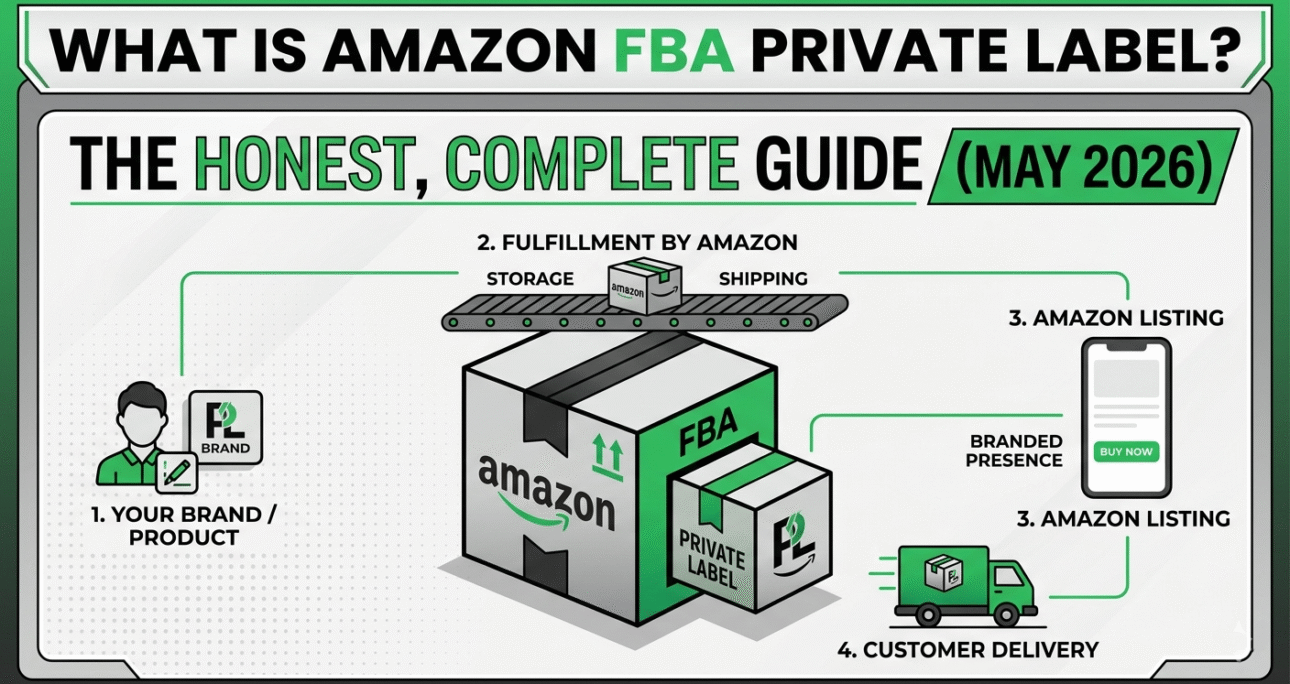
The other critical difference is fulfilment. Amazon’s FBA model means sellers ship inventory into Amazon’s warehouse and Amazon handles storage, picking, packing, and shipping. eBay has no equivalent built-in fulfilment network. You either fulfil orders yourself from home or a small warehouse, or you use a third-party fulfilment provider. The absence of FBA-equivalent fees means the margin structure is different — often better per unit — but it also means fulfilment operations are your direct responsibility.
Step 2: Set Up a Business Seller Account Correctly
The account foundation matters more on eBay than most new sellers appreciate, because eBay’s trust system is buyer-visible in a way Amazon’s isn’t. Buyers can see your feedback score, read individual feedback comments, and check your account age before purchasing. Getting the account set up correctly from the start avoids the friction of trying to fix structural problems later.
You need a business seller account rather than a personal one. A personal account has transaction limits, different fee structures, and doesn’t carry the seller protections or the credibility signals that come with a properly registered business account. If you’re operating as a sole trader, registering under your own name as a business is sufficient to access the business seller account.
The registration process itself asks for business details, contact information, and bank account information for eBay’s Managed Payments system. eBay moved entirely to Managed Payments — where eBay collects buyer payments and pays sellers directly to their bank accounts — several years ago. There’s no PayPal intermediary for the core transaction any more, which simplifies the setup considerably compared to earlier eBay generations.
When setting up the account, pay specific attention to the return policy settings. eBay’s algorithm — Cassini — considers return policy generosity as a ranking factor. A 30-day free returns policy signals to Cassini that the seller is confident in their product and committed to buyer satisfaction, which improves listing placement. Many new sellers set restrictive return policies to protect themselves and inadvertently suppress their own visibility. Start with a policy that’s competitive with the category standard, and treat it as part of the listing strategy rather than a purely defensive decision.
Handling time is another setting that affects both search placement and buyer confidence. Committing to a one-business-day handling time — and actually meeting it consistently — signals reliability to the algorithm and to buyers who read the estimated delivery dates. If your fulfilment setup can support it, this is one of the easiest early ranking advantages available.
eBay’s business seller hub provides the current requirements for registering as a business seller and the specific obligations that come with that status — worth reading before creating the account so there are no surprises about consumer rights obligations or listing requirements.
Step 3: Research and Validate Product Demand Before Committing Any Capital
Product selection is where most eBay private label attempts succeed or fail, and the research process needs to be based on actual sales data rather than category assumptions or trend intuition.
eBay’s built-in product research tool — previously called Terapeak and now integrated into Seller Hub as “Product Research” — is the most direct demand validation resource available. It shows actual sold listings, average selling prices, sell-through rates (the percentage of listed items that actually sold), and category-level demand patterns. This is real transaction data from eBay’s own marketplace, which makes it the most reliable signal available about what buyers are actually purchasing and at what price points.
The metrics to evaluate aren’t complicated but they need to be read correctly. Sell-through rate — the ratio of sold listings to total listings in a search — tells you whether the market is absorbing the available supply or whether it’s overstocked. A sell-through rate above 50% suggests buyers are finding and purchasing the product reliably. Below 30% suggests the listing supply exceeds the buying demand, which means new entrants will struggle to find buyers without being competitively better than existing options on price or listing quality.
Average selling price matters because eBay’s fee structure — typically 12-15% final value fee on the total transaction including shipping, depending on category — plus packaging, shipping costs, and product cost need to leave a workable margin. The categories with the best eBay private label margin dynamics are generally in the £15–£60 selling price range. Below this, the fixed elements of cost (packaging, label printing, shipping materials) consume too large a share of the revenue. Above it, buyer research expectations increase, return rates tend to be higher, and the capital commitment per unit is substantial.
The competitive landscape needs assessment beyond just listing count. Searching the main category term and looking at the first page of results shows who the relevant competitors are and whether a new listing can realistically appear on that page within a reasonable time frame. Listings that have been live for months with strong feedback and hundreds of positive reviews are durable competitors. Listings from sellers with lower feedback scores, thinner review comments, or listing accuracy issues are more displaceable.
For validating whether the specific search terms buyers use in the category have genuine, stable demand, the Search Term Harvester at ecommate.co.uk/tool-box/search-term-harvester/ extracts real buyer search queries so the demand basis is confirmed by actual search behaviour rather than estimated market size. On eBay specifically, the precise language buyers use to search — which often differs from how sellers describe products — determines whether a listing title captures the right traffic.
Step 4: Find and Qualify a Supplier
With validated product demand confirmed, the supplier search begins. The specific supplier approach depends on the product category, but the principles of qualification apply universally.
Alibaba is the starting point for most private label product categories. It’s the largest B2B sourcing platform in the world and provides access to manufacturers across virtually every product type. The important distinction to make from the beginning is between trading companies and manufacturers. Trading companies source from manufacturers and add a margin. Manufacturers produce the product directly. For private label specifically — where you need to control product specifications, branding, and quality — working directly with a manufacturer is preferable wherever possible, because it gives you more influence over the product and more visibility into how it’s produced.
Identifying whether an Alibaba supplier is a manufacturer or a trading company requires asking directly and requesting evidence: factory photos, production videos, and business licence documents that show their registered business type. A legitimate factory with relevant manufacturing capability can provide this readily. A trading company presenting itself as a manufacturer typically cannot, or provides documentation that doesn’t match their claims.
The qualification process after initial contact follows a consistent sequence. First, request a product specification sheet to confirm the supplier has produced the exact product type before, not just a similar one. Second, order samples — not free samples, which often don’t represent production quality, but paid samples at the production specification you’ve requested. Third, evaluate those samples against the specific criteria that matter for your eBay listing: materials, construction quality, finishing, dimensions, and any functional requirements. Fourth, if the samples pass evaluation, request a factory audit or arrange a third-party quality inspection for any bulk order before it ships.
Minimum order quantities on Alibaba typically range from 50 to 500 units for smaller products, and higher for items with significant manufacturing tooling requirements. For a first eBay private label order, the objective is to order enough to test the listing’s performance and build initial feedback without committing capital that can’t be recovered if adjustments are needed. A first order of 100–200 units for most product categories allows enough inventory to run the listing for two to three months at realistic early sales volumes while preserving capital flexibility.
Packaging specification needs to happen before the production order is placed, not after. Your packaging needs to arrive with the product — not be applied separately after delivery — and it needs to meet eBay’s category standards for how the product is presented. For most product categories, this means branded packaging with clear product identification, a logo, and any relevant specifications or instructions. The packaging also needs to survive normal postal transit conditions, since you’re fulfilling from your own location rather than a managed warehouse network.
Step 5: Build Your Brand Identity — Simple, Coherent, and Photography-Ready
eBay private label doesn’t require the brand investment that Amazon private label does, but it requires more than sellers typically give it. The benchmark isn’t “does this look like a real brand to a brand designer?” — it’s “does this look like a real product from a real seller to someone who’s never heard of it and is deciding in five seconds whether to trust it?”
The core elements are a name, a logo, packaging, and consistent visual treatment across the listing images and any seller profile materials. The name should be simple enough to remember, not so generic that it describes the category rather than identifying the brand, and available as a trademark in the relevant class if you’re serious about protecting it long-term. eBay doesn’t require brand registry in the way Amazon does, but establishing trademark ownership creates options that are difficult to access retroactively if you try to do it later.
The logo needs to work at multiple sizes because it will appear on the product packaging, potentially embossed or printed directly on the product, in a small version on the eBay listing images, and at the even smaller scale of profile elements. A simple wordmark — the brand name in a clean, distinctive typeface — often works better than a complex icon at eBay’s typical display sizes. Whatever mark is chosen should look as clear at the size of a packaging label as it does on a full-size design file.
Packaging for eBay private label doesn’t need to be as elaborate as Amazon packaging, but it needs to be functional and professional. eBay buyers photograph their purchases less frequently than Amazon buyers — the unboxing content culture that drives review photo quality on Amazon is less pronounced on eBay. What matters more on eBay is that the packaging protects the product in transit, presents it clearly when opened, and doesn’t look like it was produced with the minimum possible effort. Packaging that photographs well for your listing images is the most important functional requirement, since buyers will judge the product partly on how it looks in the listing before they ever see it in person.
Step 6: Write Your eBay Listing with Cassini in Mind
eBay’s Cassini algorithm evaluates listings on a combination of seller performance signals and listing quality signals. The listing quality signals that directly affect search placement include title keyword relevance, completeness of item specifics, description quality, and the match between the listing content and the buyer’s search query. Writing a strong listing means serving both the algorithm’s requirements and the buyer’s decision-making needs simultaneously.
The title is the most important single element in eBay listing optimisation. eBay allows up to 80 characters in the title, and that space should be used efficiently. The primary keyword — the most specific description of what the product is — belongs at the start of the title, because Cassini weighs early title terms more heavily than later ones. After the primary keyword, secondary descriptive terms that buyers commonly include in their searches should follow: material, key specification, size or colour if relevant, and any compatibility information for products where that matters.
What the title should not include: your brand name (unless buyers search for it, which they won’t at launch), marketing language (“amazing,” “best,” “high quality”), unnecessary punctuation, and keyword stuffing that reads unnaturally. A title that reads like a human product description while including the relevant search terms performs better than one that’s clearly constructed for algorithm manipulation, both because Cassini has become more sophisticated about relevance signals and because buyers who see the title in search results are also evaluating it as a trust signal.
Item specifics — the structured data fields below the title that describe the product in categorical terms — are Cassini’s primary mechanism for matching listings to specific search queries. This is one of the most underused optimisation opportunities on eBay, because most sellers fill in only the required item specifics and leave the optional ones blank. Cassini uses item specifics to filter results when buyers use eBay’s category navigation and filtered search — buyers who specify “material: stainless steel” or “size: large” in their search will only see listings where those specifics are filled in. Completing all relevant item specifics, including optional ones, significantly expands the range of searches that return the listing.
The description serves a different function than the title or item specifics. It’s where buyers who clicked through and are seriously evaluating the purchase read the detail that resolves their remaining questions. It should address the specific practical concerns of the target buyer: what the product is made of and why that matters, what the relevant specifications are, what’s included in the purchase, how it’s used, what size or compatibility considerations apply, and what the return process looks like if they’re not satisfied. eBay descriptions that read like a conversation with an attentive salesperson convert better than ones that read like a product specification sheet — the information is the same, but the framing makes the difference.
Step 7: Photograph the Product to eBay’s Standard — and Beyond It
eBay allows up to 24 product images, and using that allowance well is one of the clearest differentiators between a listing that converts and one that doesn’t. Most sellers use three to five images. Listings with twelve or more high-quality images that answer different buyer questions consistently outperform the category average.
The main image needs a clean white background and should show the product clearly at the largest practical size within the frame. This is what buyers see in search results, and it determines whether they click through. The main image doesn’t have much room for creativity — clarity and quality are the objective. A professionally photographed product on a clean white background at correct exposure signals competence before the buyer has read a word.
Secondary images are where the visual storytelling happens. Each additional image should answer a specific buyer question: what does the product look like at a different angle? What is the scale relative to a common reference object? What does it look like in use? What do the materials or construction details look like up close? For products with multiple variants, each variant should have its own clear image. For products where dimensions matter — storage products, tool sets, any product where fit is a consideration — an image showing the product with a measuring tape or alongside a familiar object to communicate scale prevents the disappointed-by-size complaints that generate negative feedback.
Lifestyle images — showing the product in realistic use contexts — help buyers visualise the product in their own situation, which reduces hesitation. An organisational product shown in an actual organised space, with realistic items in it, communicates “this is what it will look like in your home” more effectively than any descriptive text. These images don’t need to be elaborate production shoots — clean, well-lit, contextually accurate photography achieves the purpose.
Step 8: Price for Profit, Not Just for Competitiveness
Pricing is where many new eBay sellers compromise their margin without realising it until the accounting makes the losses visible.
eBay’s fees need to be fully accounted for in the price calculation. The final value fee — charged when an item sells — is typically 12-15% of the total transaction amount including postage. This is calculated on the total amount the buyer pays, including any shipping charge. Sellers who offer free shipping and price accordingly avoid the psychological barrier of visible shipping costs but need to ensure the shipping cost is absorbed into the product price without making the listing uncompetitive.
On top of the final value fee, there are insertion fees for listings beyond the free monthly allowance, potential Store subscription costs, and Promoted Listing fees if advertising is used. The cost of packaging materials, shipping labels, and the time cost of processing orders also needs to be accounted for, particularly at early volumes where that time cost isn’t spread across a large number of units.
A practical pricing model for a new eBay private label product starts with the total cost — product unit cost, inbound shipping from manufacturer, packaging materials, outbound shipping per order, and eBay fees — and works backwards from a target net margin rather than forwards from the competitor’s price. The competitive price in the category sets the ceiling: above it, sales volume will be restricted. The total cost plus minimum acceptable margin sets the floor: below it, the business isn’t profitable regardless of volume. The viable price point needs to sit between those two constraints.
For most private label products in the £15–£60 range, a net margin of 25–35% after all costs is a reasonable target for a functioning eBay private label business. Lower than this, the business is too sensitive to small cost changes or fee increases to be reliably profitable. Higher than this at launch, particularly in a competitive category, is typically only achievable once the listing has established feedback and rank that justify a premium.
Step 9: Launch, Fulfil, and Build Feedback Deliberately
The launch phase on eBay is meaningfully different from Amazon’s launch dynamic. There’s no PPC campaign structure to set up and fund, no review velocity target to hit, and no complex advertising cost to manage. The two things that matter most at launch are fulfilment reliability and feedback accumulation.
Fulfilment reliability means shipping on time, packaging correctly, and handling the inevitable early queries and issues promptly. eBay’s algorithm monitors seller performance continuously. Late shipments, cases opened by buyers, and unresolve disputes all damage seller metrics that directly affect how prominently listings are displayed. New sellers who launch with good intentions but underestimate the operational demands of fulfilling from home — especially if orders cluster during peak periods — damage their metrics in the first weeks in ways that take months to recover from.
Before the first listing goes live, the fulfilment process needs to be tested end-to-end: packaging ordered and on hand, shipping supplies ready, carrier account set up and integrated with eBay’s labels system, handling time settings confirmed against realistic capacity. The moment the listing is live, buyers can purchase, and the commitment to the stated handling time begins immediately.
Feedback is eBay’s most important trust signal, and building it deliberately from the start is the difference between a listing that converts at full speed within weeks and one that stagnates because potential buyers choose better-reviewed alternatives. eBay allows sellers to send a single follow-up message to buyers — through the eBay messaging system — after the order is marked delivered. A message that checks in on delivery, confirms the product arrived as expected, and invites the buyer to leave feedback if they’re satisfied generates feedback at a higher rate than waiting passively. It also surfaces any issues early, before they become negative feedback or cases, because buyers who are given the opportunity to communicate a problem tend to resolve it privately rather than publicly.
The target for the first two to three months is reaching 25–50 positive feedback items with specific, detailed comments about the product, the accurate listing description, and the shipping speed. That feedback profile is sufficient to establish baseline credibility for buyers evaluating the listing for the first time. It’s the eBay equivalent of the initial review base that Amazon sellers work to build through Vine and follow-up campaigns.
Step 10: Optimise, Expand, and Scale Deliberately
Once the first listing has demonstrated that it converts — buyers are purchasing, feedback is building, the margin model is holding under real operating conditions — the scaling decisions become evidence-based rather than speculative.
The first optimisation target is the listing itself. After two to three months of real buyer interaction, there will be patterns in the questions buyers ask before purchasing, the feedback comments they leave, and the item specifics they used to find the listing. Each of these is an optimisation input: questions that appear repeatedly indicate gaps in the listing that should be addressed; feedback comments that mention a specific aspect of the product positively suggest a selling point that should be more prominent in the listing; search term data from eBay’s Seller Hub shows which specific queries are driving impressions and which are converting.
Promoted Listings — eBay’s paid advertising system — becomes worth testing once the organic listing is performing and there’s data on which keywords are driving conversions. Promoted Listings operates on a cost-per-sale model where an ad rate (typically 2–15% of the sale price) is set by the seller and paid only when a buyer clicks the promoted listing and purchases within 30 days. Unlike Amazon’s cost-per-click model, there’s no charge for clicks that don’t convert, which makes it significantly more capital-efficient for early testing. The right time to turn on Promoted Listings is after the organic listing has established its baseline conversion rate — not at launch, when you don’t yet know what a normal conversion rate looks like for the product.
Expanding to additional products should follow the same validation discipline as the first product rather than accelerating past it. A second product in a related category — one that the same buyer might want, that uses the same supplier relationship where possible, and that fits the same brand identity — compounds the value of the seller account’s feedback history and brand presence more efficiently than diversifying into unrelated categories. A listing in automotive accessories that performs well creates the account reputation that makes a second automotive accessories listing convert faster than a first listing from a new account would.
An eBay Store subscription becomes financially worthwhile when monthly listing volume exceeds the free listing allowance and the fee savings on final value fees offset the subscription cost. Most private label sellers with more than five to ten active listings find the Basic Store tier (approximately £25/month) pays for itself in reduced final value fees, and the brand presentation benefits of a custom storefront with brand colours and logo contribute to the professional impression that converts new buyers.
Common Mistakes That End eBay Private Label Businesses Early
Understanding the most frequent failure patterns is as strategically valuable as the step-by-step process — because these mistakes typically don’t announce themselves until the damage is already done.
Treating eBay like Amazon in disguise is the most comprehensive mistake. The listing format, the buyer psychology, the algorithm, the fulfilment model, and the brand investment required are all different. Sellers who bring Amazon listing conventions — heavy lifestyle photography, aspirational copy, brand story-led positioning — to eBay consistently underperform sellers who invest that same energy in specification accuracy, item specifics completeness, and seller performance metrics.
Underestimating the feedback imperative is the second most common structural mistake. Amazon buyers often don’t leave reviews even after positive purchases. eBay buyers leave feedback at a higher rate, and early negative feedback from an operational failure — a late shipment, a packaging failure, a listing that didn’t match the product — can suppress a listing’s placement for months. Protecting the feedback score in the first six months is as important as any listing optimisation decision.
Pricing without full cost accounting — setting prices based on competitor prices without modelling the full cost stack — produces listings that appear competitive but lose money on every sale. The discovery of this typically happens at the end of the first month when the bank account doesn’t reflect the revenue the dashboard showed, because fees, shipping costs, and packaging costs consumed the apparent margin.
Launching multiple products simultaneously before the first one is proven spreads operational attention too thin during the period when each new listing needs the most active management. The compounding advantage of eBay private label builds through the quality of each individual listing and the seller account’s performance history — not through the quantity of listings launched in a short window.
Frequently Asked Questions
How much does it cost to start eBay private label? A realistic starting budget is £1,000–£3,000 for a first private label product on eBay. This covers the initial inventory order (typically 100–200 units), packaging design and production, product photography, and eBay’s seller account setup costs. The absence of FBA-equivalent fees makes the capital requirement materially lower than an equivalent Amazon private label launch.
Do I need a business licence to sell private label on eBay? In the UK, you need to register as a business seller on eBay and meet the consumer rights obligations that come with that status. For sole traders, this doesn’t require formal company registration, but your trading identity needs to be registered for tax purposes with HMRC if you’re generating income from the business.
How long does it take to make money from eBay private label? A well-executed first listing on eBay typically reaches consistent sales within four to eight weeks of launch, which is faster than Amazon’s equivalent timeline. Reaching net profitability — where revenue after all costs exceeds the initial investment — typically happens within two to four months for a first product, assuming product demand validation was done correctly before the inventory order.
Can I sell the same product on eBay and Amazon? Yes, and many private label sellers do. The same product needs different listing strategies for each platform — different title structure, different item specifics (eBay) vs bullet points (Amazon), different pricing to account for different fee structures, and different photography emphasis. A listing transplanted directly from one platform to the other without adaptation will underperform on both.
What categories work best for eBay private label in 2026? The strongest categories for private label on eBay are automotive accessories and tools, home improvement and DIY products, storage and organisation products, practical pet accessories, low-tech electronics accessories, office and work-from-home essentials, and replacement parts and maintenance items. These categories share a common characteristic: buyers search with high purchase intent, care about specifications over branding, and have low brand loyalty that makes private label competitive with established names.
Is an eBay Store subscription necessary when starting? Not initially. eBay provides a free monthly allowance of listings for all sellers, which is sufficient for testing a first private label product. An eBay Store subscription becomes worth the monthly cost when the listing volume exceeds the free allowance or when the reduced final value fee rates in the subscription offset the subscription cost — typically when monthly sales reach a consistent level.
The Realistic Starting Point for How Does Private label Work
eBay private label isn’t a passive income system that runs itself after launch. It’s a business — one that requires real product research, real supplier relationships, real listing quality, and real operational reliability in order to generate real results. What makes it attractive as a starting point is that the barriers to entry are more accessible than Amazon’s, the competitive dynamics are more forgiving for new sellers, and the capital required to find out whether a product works is materially lower.
The sellers who succeed at eBay private label — who build listings that rank consistently, generate reliable feedback, and compound across multiple products over time — all share one characteristic: they treated the launch seriously. They did the demand validation before ordering inventory. They qualified the supplier before committing capital. They built the listing with the buyer’s specific decision-making process in mind. They managed fulfilment operationally rather than improvising it. And they measured performance honestly against the data rather than against optimistic expectations.
That’s not complicated. But it’s also not optional.
If you want to build your eBay private label business with the product research, sourcing, branding, listing strategy, and growth management handled by a team that understands the platform’s specific dynamics, explore our eBay Private Label services — and see how the approach translates from the steps above into operational results.