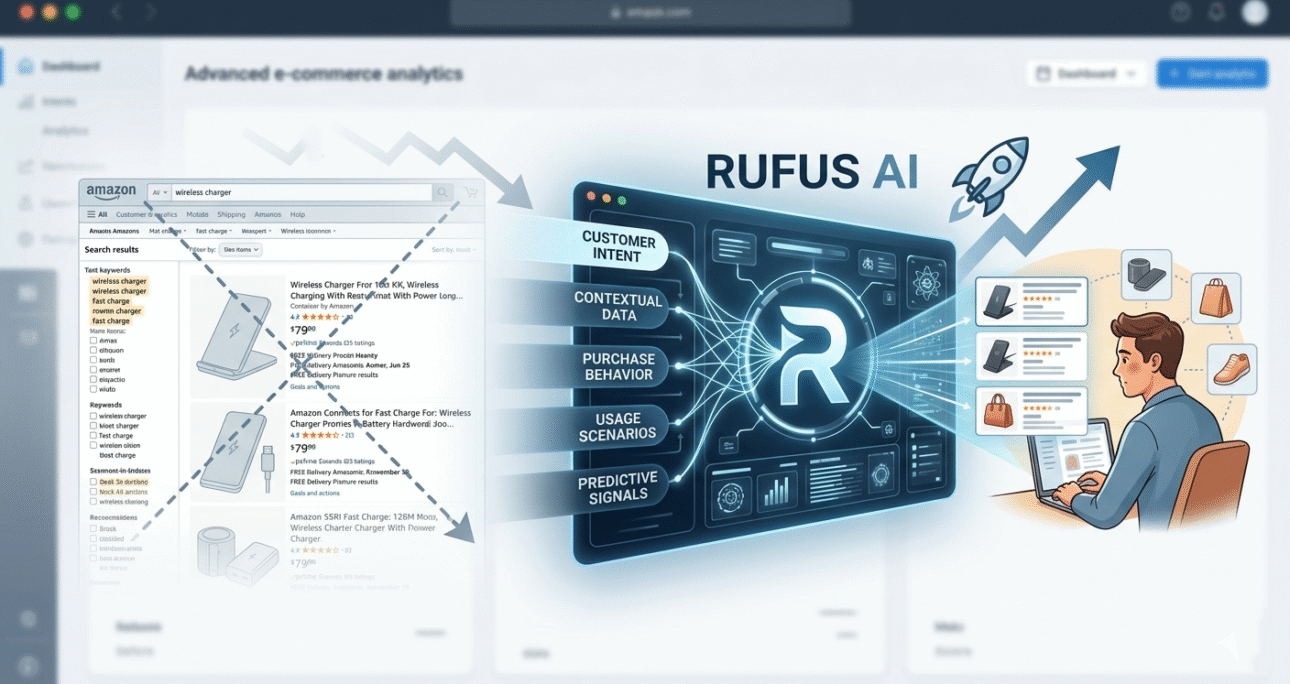
This is for Amazon sellers who’ve done everything right by the old playbook of Amazon seo — keywords researched, titles optimized, backend search terms filled — and are still watching visibility plateau or decline. The playbook didn’t become wrong. It became incomplete. Here’s what changed and what to do about it.
The Gap Between Being Indexed and Being Recommended
There’s a specific kind of frustration that’s becoming increasingly common among Amazon sellers who take their SEO seriously. They’ve used the tools. They’ve checked the indexing. The listing ranks for the primary keywords. PPC is running. By every metric the traditional approach produces, the listing looks fine.
And yet something isn’t working the way it used to. Organic visibility feels less reliable. Certain high-intent searches that should be producing impressions aren’t. Conversion rate from organic traffic has softened in ways that keyword adjustments don’t seem to fix.
The explanation for this pattern isn’t that keyword optimization has stopped working. Keywords still matter — they remain part of how Amazon’s search index operates. The explanation is that a second layer of product discovery has developed alongside the keyword-based search system, and that second layer operates on fundamentally different principles that the traditional keyword optimization approach doesn’t address.
That second layer is RUFUS — Amazon’s AI shopping assistant — and understanding how it works, what it reads, and what it recommends is increasingly important for any Amazon seller who wants their listings to be visible to buyers across the full range of how those buyers now discover products on the platform.
This guide explains the RUFUS system concretely, without unnecessary technical complexity, and provides specific actions sellers can take to ensure their listings perform well under AI-driven discovery rather than just under traditional keyword-based search.
What RUFUS Is and Where It Operates
RUFUS is Amazon’s generative AI shopping assistant, launched out of beta and now integrated throughout the Amazon shopping experience. Amazon has confirmed that RUFUS uses large language model technology — the same foundational architecture that powers tools like ChatGPT — trained specifically on Amazon’s product catalog, customer reviews, and shopping behavior data.
Amazon’s official RUFUS announcement describes how the system uses generative AI to answer shopper questions, analyze product data, and surface the most contextually relevant products — confirming that the shift from keyword matching to intent understanding is a deliberate platform direction rather than a gradual algorithm update.
The integration points where RUFUS operates are expanding, but the most significant ones for sellers to understand are the search experience, the product detail page, and the conversational shopping interface that appears in the Amazon mobile app and increasingly on desktop.
In the search experience, RUFUS surfaces products in response to natural language queries — questions and phrases that describe what a buyer needs rather than naming a specific product. A buyer who types “what water bottle won’t leak in my gym bag” isn’t entering a traditional keyword search. They’re asking a question. RUFUS is built to answer that question by evaluating which products in Amazon’s catalog best match what the question is actually asking for, and surfacing those products rather than just the listings that contain the most relevant keyword matches.
On product detail pages, RUFUS appears as a conversational interface that buyers can ask questions about specific products before purchasing. When a buyer asks “is this good for sensitive skin?” or “will this fit in a standard school backpack?” RUFUS reads the listing — including title, bullets, description, A+ content, Q&A section, and customer reviews — and generates an answer based on what it finds there. If the listing doesn’t contain information that addresses the question, RUFUS can’t generate a helpful answer, which affects the buyer’s confidence in the product and their likelihood of purchasing.
The distinction that matters most for sellers is between being indexed — having Amazon’s search algorithm know your product exists and what category it belongs to — and being recommended by RUFUS. These are two different systems with two different criteria for success. A listing can be perfectly indexed for relevant keywords and still be essentially invisible to RUFUS if the listing doesn’t provide the kind of contextual, intent-matching information the AI system is looking for.
How RUFUS Reads a Listing — The Mechanics
Understanding how RUFUS processes listing content is the foundation for understanding what needs to change about how listings are written.
Traditional Amazon SEO operates on a keyword matching model: the search algorithm identifies which keywords a listing is indexed for, compares those against what a buyer searched, and ranks listings according to a combination of relevance and performance signals. The listing’s job in this model is to contain the right keywords in the right places with sufficient density and context for the algorithm to establish relevance.
RUFUS operates on a semantic understanding model. Rather than matching words, it attempts to understand meaning — what the product is, what it’s for, who it’s designed for, what problems it solves, and how well it matches the intent behind a specific buyer’s question. It reads the listing not as a collection of keywords but as a document that should communicate the product’s full relevant context.
The specific elements RUFUS reads and synthesizes include everything visible on the product detail page and everything in the Q&A section. This means title, bullet points, product description, A+ content, and every customer review contribute to the picture RUFUS forms of what the product is and who it’s for. It also means the Q&A section — which most sellers treat as an afterthought — is actually one of the highest-value elements for RUFUS optimization because it contains explicit question-and-answer pairs that map directly to the conversational queries RUFUS is designed to respond to.
The practical implication is that RUFUS’s assessment of a listing is a holistic one. A listing that has excellent keyword coverage in the title but thin, vague bullet points and an empty Q&A section may rank well in traditional keyword search while performing poorly in RUFUS recommendations, because RUFUS found insufficient context to confidently recommend the product for use-case-specific queries.
Conversely, a listing that goes beyond keyword placement to genuinely describe who the product is for, what situations it performs best in, what specific concerns it addresses, and what distinguishes it from alternatives — even if that listing doesn’t achieve perfect keyword density on every relevant term — provides RUFUS with the contextual information it needs to recommend the product confidently for the specific queries where it’s genuinely a good match.
The Shift in How Buyers Are Searching
The rise of RUFUS reflects a real shift in how buyers are using Amazon’s search function, not just a change in how Amazon’s backend processes queries. Buyers, increasingly accustomed to conversational AI interfaces through tools like ChatGPT, Google’s AI Overviews, and voice assistants, are bringing the same conversational search behavior to Amazon.
The difference between how buyers searched in 2022 and how many buyers search now is measurable in the length and specificity of search queries.
Search Engine Land’s coverage of Amazon’s AI search developments has been tracking this behavioral shift as it’s emerged — the pattern of longer, more conversational queries replacing short keyword searches is documented across multiple search platforms simultaneously, which suggests it reflects a genuine change in how people use search rather than an Amazon-specific phenomenon.
Short, keyword-style searches — “water bottle,” “desk lamp,” “running shoes” — are being supplemented by longer, more specific, more conversational queries that describe the buyer’s specific situation and need.
“Best water bottle for someone who forgets to drink enough water” is a real search pattern that RUFUS handles well and that traditional keyword-based search handles poorly. “LED desk lamp that won’t give me headaches” is another. “Running shoes for someone with wide feet and knee problems” is another. These queries contain keywords — water bottle, desk lamp, running shoes — but the dominant content is situational context that describes who is asking and what their specific requirements are.
A listing optimized purely for keyword matching will appear in these searches if the keyword is present. But appearing and being recommended are different outcomes. RUFUS evaluates whether the listing actually addresses the specific situation the buyer described — whether the water bottle listing mentions anything about hydration reminders, whether the desk lamp listing addresses flicker rates and eye strain, whether the running shoe listing addresses wide width options and joint support. If the listing doesn’t address the specific situation, RUFUS doesn’t recommend it strongly, regardless of keyword relevance.
This creates a specific gap for sellers who’ve optimized for keyword density but haven’t invested in situational specificity. They appear in searches but don’t get recommended by the AI layer that’s increasingly influencing which products buyers actually look at and consider. The traffic implications are real — being present in search results without being recommended by RUFUS is becoming less valuable as the proportion of discovery happening through AI-mediated recommendations increases.
What RUFUS-Optimized Listing Content Actually Looks Like
The transition from keyword-optimized to RUFUS-optimized content requires a shift in the fundamental question driving listing copy. The old question was: what keywords need to be present in this listing? The new question is: what does a buyer who is the ideal customer for this product need to know, and is it clearly communicated here?
These questions aren’t entirely different — the keywords that need to be present are often the same — but they lead to significantly different copy when followed through completely.
Titles that provide use-case context
A traditional keyword-optimized title leads with the product category and primary keywords, adds modifiers for secondary keyword coverage, and fills remaining space with additional terms. The result is a title that covers keyword real estate efficiently but communicates primarily to search algorithms rather than to buyers or to RUFUS.
A RUFUS-optimized title maintains the primary keyword and product category — these remain important for indexing — but adds contextual signals that communicate use cases, user profiles, or key distinctions. “Stainless Steel Water Bottle 32oz — Leak-Proof, Insulated, Ideal for Gym and Hiking” is performing the same keyword function as a purely optimized title while adding the use-case signals (gym, hiking) and product characteristic signals (leak-proof, insulated) that RUFUS reads as contextual evidence for situational recommendations.
The principle is that every phrase in the title should serve either the buyer’s quick understanding or RUFUS’s contextual assessment — ideally both. Phrases that serve neither — keyword clusters that improve indexing marginally but don’t communicate anything useful — are taking space that better contextual signals could occupy.
Bullet points written for situations rather than features
The traditional bullet point structure lists product features — materials, dimensions, certifications, included components. These features matter and should be present. But feature lists communicate to buyers and to RUFUS in the same way a specification sheet communicates — they provide facts without context, and context is what RUFUS needs to make situational recommendations.
Situationally written bullet points translate features into contexts. Instead of “BPA-free materials,” a situationally written bullet says “Safe for daily use — BPA-free and tested for health-conscious users, parents, and athletes who want clean hydration.” The feature (BPA-free) is present and searchable. But surrounding it is the context that tells RUFUS who this product is for and in what situations it’s appropriate.
Each bullet should answer an implicit question: who is this for, when would they use it, and why does this feature matter for that person in that situation? A seller who writes five bullets with this framework has provided RUFUS with five explicit contextual signals rather than five feature declarations that require RUFUS to infer their significance.
A+ Content that addresses buyer questions rather than showcasing brand assets
Most A+ content is built around brand presentation — large images, brand story, visual lifestyle content that creates an impression of quality and legitimacy. This content serves real purposes, particularly for brand building and for the trust signals that affect conversion rate. But it often doesn’t address the specific questions buyers ask before purchasing, which means it doesn’t contribute meaningfully to RUFUS’s contextual assessment.
A+ content sections that address explicit buyer questions — “Is this right for sensitive skin?” with a direct, specific answer; “How does this compare to similar products?” with an honest differentiation explanation; “What situations is this designed for?” with specific use cases — provide RUFUS with exactly the kind of question-and-answer content it’s designed to process and apply to conversational buyer queries.
The most effective A+ content for RUFUS performance combines the trust-building visual presentation that affects human buyer psychology with specific question-addressing text sections that give RUFUS contextual information to work with. Neither element alone is optimal — the best A+ content serves both the human buyer and the AI recommendation system simultaneously.
The Q&A Section: The Most Underutilized RUFUS Asset
Of all the listing elements that RUFUS reads, the Q&A section is the one where the gap between current seller practice and optimal RUFUS performance is largest, which makes it the highest-leverage area for improvement.
Most Amazon listings have either no Q&A content or only the questions buyers have organically asked — typically focused on basic logistics like shipping times, sizing, and color options. These questions are answered by sellers or by other buyers, and they’re useful for their original purpose. But they don’t represent a strategic approach to building the contextual information that RUFUS needs to recommend the product for the full range of relevant buyer situations.
RUFUS reads the Q&A section as a source of explicit information about product capabilities, appropriate use cases, user suitability, and comparison with alternatives. When a buyer asks RUFUS “is this suitable for someone with arthritis?” on a product detail page, one of the first places RUFUS looks for relevant information is the Q&A section. If that section contains a question and answer explicitly addressing joint mobility or ease of grip, RUFUS can generate a helpful, confident response. If it doesn’t, RUFUS may generate a vague or uncertain response, which reduces the buyer’s confidence and the likelihood of purchase.
The practical implication is that sellers should approach the Q&A section as a proactive content strategy rather than a reactive customer service function. Identifying the questions that the ideal buyer for this product would ask before purchasing — questions about suitability for their specific situation, questions about compatibility with their particular needs, questions that compare this product to alternatives — and adding well-written answers to those questions creates the Q&A content that RUFUS needs while also serving buyers who are asking the same questions organically.
A listing with ten to fifteen thoughtful questions and specific, helpful answers performs significantly better in RUFUS recommendations for situational queries than an equivalent listing with an empty or sparse Q&A section. The investment required — identifying the right questions, writing thorough answers — is modest. The RUFUS visibility improvement is real.
Backend Search Terms in the RUFUS Era
Backend search terms remain a legitimate and valuable component of Amazon listing optimization, but the approach to selecting them should evolve to reflect how RUFUS and buyers are now using search.
Traditional backend optimization fills the available character space with keyword variations — different orderings of the primary keywords, plurals and singulars, common misspellings, related category terms. This approach is designed to maximize the keyword surface area the listing is indexed for, with the assumption that more indexing equals more visibility.
The limitation of this approach in the RUFUS era is that it optimizes for what buyers were searching for rather than what they’re searching for now. As query patterns become more conversational and specific, the most valuable backend search terms are increasingly phrases that reflect how buyers naturally describe their needs rather than isolated keywords.
Natural language phrases that describe specific buyer situations — “fits inside a standard gym bag,” “safe for kids with nut allergies,” “suitable for someone with limited hand strength,” “designed for small apartment kitchens” — don’t always align with the keyword cluster approach that traditional backend optimization produces. But they do align with the conversational queries RUFUS is designed to respond to, which makes them worth including even if their individual search volume is lower than the primary keywords.
The optimal backend strategy in 2026 combines traditional keyword coverage for the indexing benefits that remain important with natural language phrase coverage that targets the conversational query patterns RUFUS prioritizes. Both types of terms serve legitimate purposes in the current Amazon search ecosystem, and treating them as competing approaches rather than complementary ones produces worse results than integrating them.
Customer Reviews as RUFUS Input — What This Means Strategically
One aspect of RUFUS’s operation that most sellers haven’t fully considered is that customer reviews are part of the content RUFUS reads and synthesizes when forming product recommendations. This has specific implications for how sellers should think about their review strategy and their listing optimization approach in relation to each other.
RUFUS uses customer reviews as contextual validation — when buyers mention specific use cases, confirm suitability for particular situations, or describe their experience with the product in language that matches the buyer’s query, RUFUS incorporates this as evidence for product recommendations. A product with multiple reviews mentioning “perfect for travel,” “lightweight enough for kids,” and “held up well in the gym” has built RUFUS-readable contextual evidence through its review content that supplements the listing’s own contextual claims.
This creates a reinforcing relationship between listing quality and review quality. A listing that sets accurate, specific expectations — clearly communicating who the product is for and what situations it performs well in — tends to attract buyers whose actual use cases match the listing’s claims. Those buyers’ reviews confirm the listing’s contextual claims, which provides RUFUS with additional evidence for those specific use cases, which improves the listing’s performance in RUFUS recommendations for those use cases.
Conversely, a listing that’s vague about use cases or that overpromises for situations the product doesn’t actually serve well generates reviews that may contain complaints about the mismatch between listing claims and product performance. These reviews provide RUFUS with negative contextual evidence that can suppress recommendations even when the listing itself appears well-optimized.
The strategic implication is that RUFUS optimization and customer experience are more tightly connected than traditional keyword SEO was — improving RUFUS performance through better listing context is most sustainable when the contextual claims the listing makes are accurate and are validated by buyer reviews over time.
The Listings That Are Losing RUFUS Visibility Right Now
Understanding which listing characteristics are most associated with poor RUFUS performance helps sellers identify where to prioritize improvement.
Listings that rely entirely on keyword density without contextual development are the most directly affected. These listings were optimized for a system that matched keywords rather than understood intent, and they haven’t been updated to provide the situational context that RUFUS requires. They may maintain strong traditional keyword rankings while receiving minimal RUFUS recommendation visibility for conversational queries.
Listings with empty or minimal Q&A sections are missing what is increasingly one of RUFUS’s primary sources of specific product information. For buyers who use the RUFUS assistant to ask product-specific questions before purchasing, a listing without a substantive Q&A section gives RUFUS limited material to work with, which produces vague or uncertain AI responses that don’t support confident purchase decisions.
Listings written primarily in feature declaration style — bullets that list product attributes without explaining their significance for specific buyers — provide RUFUS with facts but not context. RUFUS can infer some contextual meaning from feature declarations, but listings that make the contextual meaning explicit perform more reliably in situational recommendations than those that require inference.
Listings in competitive categories where other sellers have already updated for RUFUS performance are at relative disadvantage regardless of their absolute content quality, because RUFUS recommendations are comparative — the products that appear most contextually relevant for a specific query are recommended ahead of those that appear less relevant, even if both listings are technically well-optimized by traditional standards.
A Practical Optimization Process for RUFUS Performance
Rather than presenting an abstract checklist, the most useful framing is a prioritized process that moves from highest-leverage to lower-leverage improvements.
The starting point should be reading the existing listing as if encountering it for the first time as a buyer with a specific situation. Not as an SEO exercise — not checking keyword presence or density — but genuinely asking: if I were a buyer trying to determine whether this product fits my specific needs, what questions would I have, and does this listing answer them? The questions that the listing doesn’t answer are the optimization opportunities.
From that evaluation, Q&A section development is typically the highest-leverage action because it’s the most direct way to add specific, contextual information in a format that RUFUS processes effectively. Identifying the ten to fifteen questions that the ideal buyer for this product would most commonly ask before purchasing, and writing specific, helpful answers to each, is work that pays returns through both RUFUS visibility and human buyer confidence.
Bullet point revision should follow, focused on the shift from feature declaration to situational description. Identifying which features have the clearest contextual significance for specific buyer profiles and rewriting those bullets to make the contextual significance explicit produces immediate improvement in the contextual signals available to RUFUS. Not all five bullets need to change simultaneously — even two or three revised toward situational specificity provides measurable contextual improvement.
A+ content review should assess how much of the current content provides RUFUS-readable contextual information versus how much is purely visual brand presentation. Adding at least one or two text-heavy sections that directly address common buyer questions — even if they’re formatted to integrate with the visual presentation — increases the contextual information available to RUFUS without requiring a complete A+ redesign.
Backend search term review should add natural language phrases that reflect conversational query patterns alongside the existing keyword coverage, particularly phrases that describe specific use cases, user profiles, or situational applications that are relevant to the product but aren’t covered by the primary keyword strategy.
Frequently Asked Questions About RUFUS and Amazon SEO
Does optimizing for RUFUS AI hurt traditional keyword rankings?
No, and the concern that RUFUS AI optimization might come at the expense of traditional keyword performance reflects a misunderstanding of what the optimization involves. The changes that improve RUFUS performance — adding contextual language, writing situationally specific bullets, developing the Q&A section — don’t remove keywords or reduce their prominence. They add context around keywords and in sections that don’t affect keyword indexing. The two optimization approaches are additive rather than competing.
How quickly does RUFUS AI optimization produce results?
Results from listing content changes typically appear within two to four weeks as Amazon’s systems re-index the updated content. RUFUS AI recommendations are dynamic and respond to content changes faster than traditional organic rankings in many cases, because RUFUS AI reads the current listing content rather than working from a ranking history that takes longer to update. Sellers who make significant Q&A and bullet point improvements often report visible changes in impressions and conversion patterns within a month of updating.
Is RUFUS AI more important for some product categories than others?
RUFUS AI impact varies by category based on how much buyers’ purchase decisions involve situational complexity. Products with many potential use cases, products that need to be matched to specific user characteristics, and products in categories where buyers have specific concerns or requirements before purchasing tend to show stronger RUFUS AI effects than straightforward commodity products with simple, universal applications. That said, the conversational query trend is affecting all categories, and RUFUS AI optimization provides benefit across the range.
Can PPC performance be affected by RUFUS AI optimization?
Yes, positively. PPC sends traffic to listings, and the conversion rate of that traffic is affected by how well the listing answers the buyer’s questions. A listing that has been optimized for RUFUS AI performance — with specific contextual information, a developed Q&A section, situationally written bullets — converts better from paid traffic because buyers arriving from various query types find their specific questions addressed. This conversion improvement reduces effective ACOS without requiring bid changes.
What’s the single highest-impact change a seller can make for RUFUS AI performance?
Developing the Q&A section is consistently the highest-impact single change, primarily because it has the lowest current optimization level across most listings. Most listings have either no Q&A content or only organic buyer questions, which means the bar for competitive improvement is low and the potential for immediate RUFUS visibility improvement is high. Adding ten to fifteen specific, contextually relevant questions and thorough answers typically produces faster and more visible results than equivalent investment in any other listing element.
Final Thought: Amazon Has Become a Decision Engine
The framing that captures what RUFUS represents most accurately is the shift from Amazon as a search engine to Amazon as a decision engine. A search engine surfaces options in response to queries. A decision engine recommends specific choices in response to needs — understanding not just what the buyer typed but what they’re trying to accomplish and which product best serves that goal.
This shift changes the competitive dynamic in a specific way. In a search engine environment, the primary competitive lever is appearing — being visible in the right searches. In a decision engine environment, the primary competitive lever is being recommended — being the product the AI system surfaces when it’s trying to help buyers make the right choice for their specific situation.
Being recommended requires something that appearing doesn’t: genuine contextual relevance. The listing needs to actually be the right product for the buyer’s situation, and it needs to communicate that contextual fit clearly enough for RUFUS to recognize and surface it. Listings that achieve this — that combine strong keyword indexing with rich situational context, thorough Q&A development, and accurate, specific communication about who the product serves and how — are the listings that win in the current Amazon environment.
Keywords remain the foundation. Context is increasingly the competitive advantage.
If you’re building or refining an Amazon presence and want your listings optimized for both traditional search and RUFUS-driven discovery, you can explore how we approach listing strategy at ecommate.co.uk.