This is for Amazon sellers who’ve been treating the Big Spring Sale as a minor seasonal event and wondering why their competitors seem to be capitalizing on March traffic in ways they’re not. The sale has grown into something meaningfully different from what it was two years ago, and the sellers who haven’t updated their approach to reflect that are leaving real revenue behind.
How a Seasonal Sale Became a Major Ecommerce Event
There’s a pattern in how Amazon’s sales events evolve that’s worth recognizing, because it keeps repeating. Prime Day started as a one-day sale celebrating Amazon’s anniversary. It was modest by current standards, skeptically received by many sellers who weren’t sure it would amount to anything significant, and treated by plenty of established merchants as a secondary priority. Within a few years it had become the biggest annual sales event in ecommerce outside of Black Friday and Cyber Monday.
Amazon’s Big Spring Sale is following a recognizable version of that trajectory.
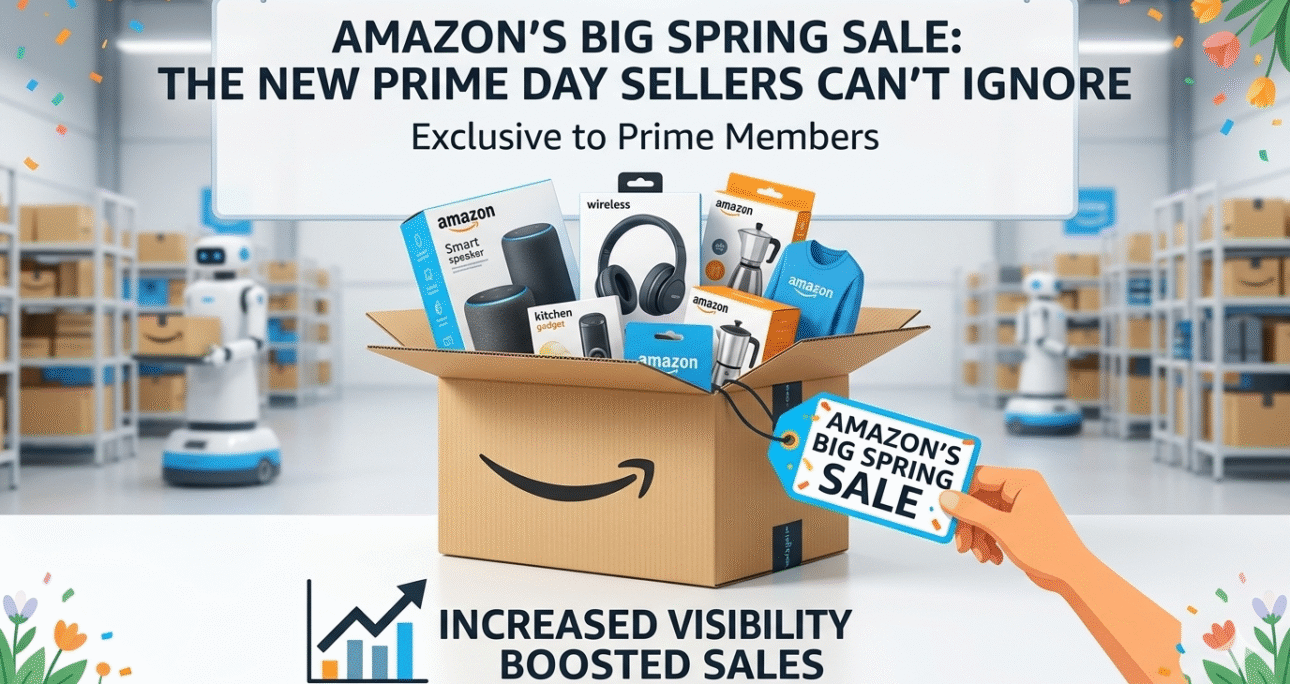
What started as a spring clearance-style promotion with modest discounts across a limited category range has grown, particularly in its 2026 iteration, into a seven-day event running March 25 through March 31, spanning more than 35 product categories, featuring discounts reaching forty to fifty percent on significant products, and structured with the rotating daily deals and urgency mechanics that characterize Prime Day’s most effective engagement tactics.
The sellers who recognized Prime Day’s potential early and built operational systems to capitalize on it consistently outperform the sellers who treated it as just another promotional period. The same dynamic is developing with the Big Spring Sale, and the window for getting ahead of the competition in preparing for it is narrower than most sellers realize.
This piece examines what the Big Spring Sale has become, why it matters strategically beyond just the sale period itself, and what sellers need to do differently to extract meaningful value from it rather than watching the traffic spike pass by with suboptimal conversion.
What Makes the 2026 Big Spring Sale Different from Previous Years
The most significant structural change in the Big Spring Sale over recent years is the shift from a clearance-style discount event to a demand-generation event with genuine Prime Day-scale mechanics.
Clearance events are essentially inventory management tools that happen to generate revenue. The goal is moving stock that would otherwise sit in storage, and the discounts are typically whatever it takes to accelerate sell-through. Buyers who participate in clearance events are primarily bargain hunters whose attention is captured by deep discounts on items they may not have been actively considering.
Demand-generation events work differently. They create buying occasions — they tell buyers that now is a meaningful time to purchase things they might have been considering anyway, and they provide the social proof of widespread participation that makes buyers feel confident pulling the trigger on purchases they’ve been deferring. Prime Day is the clearest example of this: it doesn’t primarily generate sales of things buyers didn’t want, it accelerates sales of things buyers already wanted by creating urgency and social validation around a specific time window.
The 2026 Big Spring Sale is functioning more like a demand-generation event than a clearance event.
Amazon’s official Big Spring Sale announcement confirms the scale and structure of the event — the seven-day format, the category breadth, and the deal rotation mechanics that distinguish it from earlier, more modest iterations of the same promotion.”
The discounts are deep enough — forty to fifty percent in many categories — to be genuinely compelling rather than nominally promotional. The seven-day duration with rotating daily deals creates repeat engagement rather than a single traffic spike. The category breadth — spanning technology, home and kitchen, fashion, beauty, outdoor products, and more — means the event reaches buyers across essentially the full range of Amazon’s marketplace rather than just the categories where seasonal clearance is natural.
The practical difference for sellers is significant. A clearance event creates an opportunity to move specific inventory efficiently. A demand-generation event creates an opportunity to acquire new customers, build brand awareness, and generate the sales velocity that affects organic ranking for months after the event ends. Sellers who approach the Big Spring Sale as the former type of event are systematically underinvesting in what has become the latter.
The Strategic Logic Behind Amazon Creating Multiple Peak Seasons
Understanding why Amazon is investing in developing the Big Spring Sale into a major event is useful context for sellers trying to anticipate where the platform is heading and what that means for their operations.
Amazon’s historical revenue pattern has been heavily weighted toward Q4 — the combination of Black Friday, Cyber Monday, and the holiday shopping season generates a disproportionate share of annual platform revenue. This concentration creates operational challenges: fulfillment network strain during the peak, underutilization during quieter months, and a revenue profile that’s more volatile than Amazon would prefer.
Prime Day was the first major attempt to create a meaningful mid-year peak, and it succeeded dramatically. By making July a genuine shopping event rather than a seasonally slow period, Amazon improved revenue distribution, increased Prime membership value, and created an additional point in the year where sellers invest in inventory and advertising in anticipation of elevated demand.
The Big Spring Sale represents the next step in this strategy — creating a meaningful Q1 peak that fills the gap between post-holiday January and mid-year July. From Amazon’s perspective, the benefits are clear: improved annual revenue distribution, increased seller investment in Q1 inventory and advertising, more occasions for Prime membership value demonstration, and a more year-round engagement pattern from buyers who might otherwise only think about Amazon seriously during Prime Day and Q4.
For sellers, this strategic direction means accepting and planning around a reality that the platform is actively creating: there are now multiple major selling events throughout the year rather than just one or two, and consistent operation across all of them is increasingly necessary for competitive performance rather than optional for ambitious sellers.
The sellers who’ve adapted their operational planning to treat the ecommerce calendar as having four or five meaningful peaks rather than two are consistently outperforming the sellers who’ve maintained the old model of optimizing for Prime Day and Q4 while treating everything else as background noise. The Big Spring Sale is the clearest current example of this shift, but it represents a direction rather than a single change.
What the Sales Data Tells Us About Buyer Behavior During the Event
Category performance during the Big Spring Sale reveals buyer behavior patterns that are worth understanding for inventory and advertising planning purposes, because the products that sell well during this event are meaningfully different from the products that drive Q4 performance.
Technology and electronics perform strongly during the spring sale, consistent with the broader pattern of significant tech purchases clustering around major sales events regardless of the specific event. Buyers who have been monitoring prices on specific tech items — laptops, tablets, smart home devices, audio equipment — use the sale as the trigger to purchase rather than continuing to wait. The specific items that perform best are often the same items that perform well during Prime Day, which suggests that the spring sale is capturing demand from buyers who weren’t ready to purchase in July or November rather than creating fundamentally new demand.
Home and kitchen is typically the strongest category during the spring sale specifically, because of the seasonal psychology of spring refreshing. Buyers who are thinking about spring cleaning, home organization, cooking at home more as weather improves, and generally refreshing their domestic environment are in an active purchasing mindset during March and April that doesn’t apply in July. The spring sale captures this seasonal demand at a moment when Amazon’s promotional mechanics can accelerate it. Sellers in home and kitchen who treat this event seriously consistently report it as their strongest early-year revenue period.
Beauty and personal care performs well as buyers invest in spring skincare routines, preparation for outdoor season, and the general personal renewal that spring tends to prompt. This is a high-repeat-purchase category where acquiring new customers during a sale event can produce significant lifetime value through subsequent full-price repurchases — which makes the advertising investment in beauty categories during the spring sale potentially more valuable than the immediate sale revenue alone suggests.
Outdoor and seasonal products experience their most meaningful sales velocity window of the year beginning in late March, as buyers prepare for spring and summer outdoor activities. The spring sale coincides precisely with the beginning of this window, making it the highest-impact promotional moment in the outdoor category calendar. Sellers in outdoor categories who don’t participate in the spring sale are missing the largest demand spike of their year.
Fashion and apparel reflects the seasonal transition as buyers update their wardrobes for warmer weather. The conversion dynamics in apparel are slightly different from other categories because return rates are higher, but the volume opportunity during the spring sale is substantial enough that sellers with strong product-market fit and accurate sizing communication can generate significant net revenue despite higher return rates.
Why the Spring Sale Is Valuable Beyond the Revenue It Directly Generates
The most sophisticated sellers approach the Big Spring Sale with a value framework that extends beyond the revenue generated during the seven days of the event. Understanding the full value of the event changes the investment case for participation and explains why sellers who treat it seriously tend to compound advantages that extend well into the rest of the year.
Organic ranking momentum is the most significant indirect benefit. Amazon’s ranking algorithm responds strongly to sales velocity — the rate at which a product sells relative to its history and its competitive context. A significant sales spike during the spring sale generates the kind of velocity signal that can meaningfully improve a product’s organic ranking for weeks after the event ends. Sellers who enter the event with well-optimized listings and adequate inventory to support elevated sales volume exit it with ranking improvements that generate additional organic traffic throughout spring and early summer, amplifying the event’s revenue impact well beyond the seven-day window.
Customer acquisition at promotional cost is the second major indirect benefit. New customers acquired during sale events — buyers who purchased for the first time because the discount made the trial feel lower-risk — become potential full-price repeat customers if the product and brand experience justifies their return. The effective customer acquisition cost during a major sale event, accounting for the margin reduction from the discount, is often favorable compared to the cost of acquiring equivalent customers through PPC advertising. Sellers who monitor repeat purchase rates from spring sale customers frequently find that the event is their most efficient customer acquisition vehicle of the year.
Competitive intelligence and product validation constitute the third indirect benefit. The spring sale’s elevated traffic and purchase volume creates a compressed period of intensive market feedback. Which products convert well at promotional pricing? Which don’t, suggesting problems with the product or listing that aren’t apparent at lower traffic volumes? Which competitor products are performing strongly, indicating market shifts worth understanding? The data density of a major sale event is significantly higher than typical operating periods, and sellers who systematically track and analyze spring sale performance extract insights that inform better decisions for the rest of the year.
Prime Day preparation is the fourth. The Big Spring Sale functions as a real-world rehearsal for Prime Day at meaningful traffic volumes. Inventory forecasting accuracy, PPC campaign structure effectiveness, listing conversion performance under elevated competition, fulfillment capacity, and customer service volume can all be tested and refined during the spring sale in ways that produce specific improvements to Prime Day readiness. Sellers who use the spring sale explicitly as a Prime Day preparation exercise consistently outperform their own Prime Day expectations.
The Listing Optimization Requirement — Why Preparation Timing Matters
One of the most consistent mistakes sellers make with major sale events is treating listing optimization as something that happens during the event rather than before it. The belief seems to be that traffic will convert regardless of listing quality during a high-volume promotional period because buyer motivation is elevated. This belief is incorrect and costs sellers measurable revenue every major sale event.
The mechanism works like this: during major sales events, buyer attention is simultaneously more abundant and more competitive. More buyers are actively looking for products to purchase, which increases total traffic. But those same buyers are also evaluating more options simultaneously, making more rapid decisions, and showing less patience for listings that require effort to understand. The cognitive shortcuts that experienced buyers use become more pronounced during sales events — they’re making faster decisions with higher stakes and less tolerance for friction.
A listing that’s marginally adequate under normal traffic conditions performs worse than average during a major sale event because the elevated traffic includes a higher proportion of buyers who are in rapid evaluation mode. A listing that’s well-optimized for conversion — clear value communication, strong images, specific and relevant use-case context, well-developed Q&A section — performs better than average during the same event because it resolves buyer uncertainty quickly in an environment where buyers want to move fast.
The timing requirement is practical: listing optimization takes time to implement properly and some additional time for Amazon’s systems to re-index and reflect the changes. Listing changes made the day before a sale event don’t fully propagate before the event begins. Optimization work completed two to three weeks before the event is reflected in the listing’s performance when the event traffic arrives.
This means sellers who intend to benefit from the Big Spring Sale’s traffic need to treat their listing preparation as a pre-event project rather than a concurrent-with-event activity. The content work, image improvement, Q&A development, and backend search term refinement that produces better conversion during the event needs to be complete before the event starts.
Advertising Strategy During the Big Spring Sale
The advertising environment during major Amazon sales events is more competitive and more expensive than standard operating conditions, and the sellers who extract the most value from their advertising spend during these periods are typically the ones who’ve thought through their strategy in advance rather than scaling their normal approach up proportionally.
Competition for advertising placement increases because more sellers are simultaneously investing in visibility during high-traffic periods. This drives up cost-per-click across most categories in ways that can make standard bidding strategies unprofitable if applied without adjustment. Sellers who approach the spring sale with standard bids and standard campaign structures often find their advertising efficiency deteriorating during the period of highest potential return.
The adjustment that produces better results is thinking about advertising during sale events in terms of customer acquisition cost rather than immediate return on ad spend. A new customer acquired during the spring sale through advertising investment that exceeds normal ROAS thresholds may justify the investment if the probability of repeat purchase at full price is high. Categories with strong repeat purchase behavior — consumables, products with natural replacement cycles, items that prompt accessory purchases — have more favorable customer acquisition economics than one-time purchase categories, which affects how aggressively to invest in advertising during the event.
Sponsored Brands and Display advertising become more valuable during sale events relative to their normal performance because they serve awareness and consideration functions alongside direct conversion. During high-traffic periods when buyers are actively in discovery mode, exposure through these ad types creates brand familiarity that influences purchase decisions even when the buyer doesn’t click the initial ad. Sellers who invest exclusively in Sponsored Products during sale events miss the brand awareness value of the elevated traffic volume.
Dayparting — adjusting advertising spend by time of day — is particularly relevant during multi-day sale events. The Big Spring Sale’s seven-day duration creates variation in peak hours across the week, and the deal rotation pattern means that buyer activity spikes at specific times when new deals are revealed. Sellers who identify when their category’s buyers are most actively engaged during the event and concentrate advertising spend in those windows extract better efficiency from the same total budget.
Inventory Management for the Spring Sale — What Sellers Get Wrong
Inventory planning for the Big Spring Sale is where seller preparation most commonly fails, typically in one of two directions that both produce significant revenue loss.
Under-stocking relative to event demand is the more commonly discussed problem. Sellers who forecast conservatively to avoid storage costs or capital commitment end up selling out early in the event period, which produces the worst possible outcome: maximum demand during the period when the seller can’t fulfill it. The organic ranking improvement from velocity that the event was supposed to generate doesn’t happen because sales stopped when inventory ran out. New customers who wanted to purchase couldn’t, and won’t necessarily return when inventory is replenished. The advertising spend invested before the stockout generated traffic that couldn’t convert.
Over-stocking is the less discussed problem but equally real. Sellers who dramatically over-forecast event demand to avoid stockout risk end up with excess inventory that accumulated during peak FBA storage rate periods, that requires significant discounting to clear, and that ties up capital that could have been deployed more efficiently. The over-stocking problem is particularly acute for sellers who don’t track event performance carefully and discover post-event that their demand forecast was significantly optimistic.
The solution to both problems is the same: using historical sales data to build event forecasts rather than relying on intuition or simple multiples of standard weekly velocity. Sellers who’ve participated in previous spring sales have the most valuable data — their own historical spring sale sell-through rates, adjusted for any product improvements or competitive changes since then. Sellers who don’t have spring sale history should use their Prime Day or Black Friday sell-through rates as proxies, adjusted downward to account for the spring sale’s smaller current scale relative to those events.
The specific adjustment factor depends on category and product characteristics, but a starting point of fifty to sixty percent of Prime Day volume is reasonable for most products without specific evidence suggesting otherwise. This should be refined by examining category-level spring sale data from public sources and by tracking early-day sales velocity on the first day or two of the event to determine whether actual demand is tracking above or below forecast.
Using the Spring Sale as a Prime Day Preparation Exercise
The most strategically sophisticated use of the Big Spring Sale is treating it explicitly as a rehearsal for Prime Day rather than as an independent objective. Sellers who adopt this framing consistently report better Prime Day outcomes than sellers who treat the two events as separate planning exercises.
The rehearsal value operates across several dimensions. Inventory forecasting accuracy improves when sellers have recent spring sale data to calibrate their models. A seller who forecasted spring sale volume, tracked actual sell-through rate, and measured the accuracy of their forecast has specific, recent evidence about how their forecasting approach performs for their specific products in an elevated-demand environment. Applying that learning to Prime Day forecasting produces better outcomes than relying on older data or broader category benchmarks.
Advertising campaign structure refinement is a second rehearsal benefit. The campaign structures, bidding strategies, and keyword targeting that a seller runs during the spring sale can be evaluated against actual performance data and optimized before Prime Day. Sellers who test new campaign structures during the lower-stakes spring sale — where the cost of a suboptimal approach is lower than during Prime Day — arrive at Prime Day with evidence-based campaign structures rather than untested assumptions.
Listing conversion performance under elevated competitive conditions is the third rehearsal dimension. Spring sale traffic is more competitive than standard operating conditions but less competitive than Prime Day in most categories. This makes it an intermediate test of listing performance — sellers can identify conversion weaknesses that become apparent under elevated competition without the full stakes of Prime Day’s more intense competitive environment. Improvements made to listings between the spring sale and Prime Day are informed by specific performance evidence rather than general optimization principles.
Customer service volume and response capacity is a fourth rehearsal dimension that sellers frequently overlook. Major sale events generate significantly more customer inquiries, return requests, and account contacts than standard operating periods. Sellers who haven’t stress-tested their customer service capacity during an elevated-demand period often discover capacity constraints during Prime Day that would have been addressable if identified earlier. The spring sale’s elevated volume, while smaller than Prime Day, is typically sufficient to reveal customer service bottlenecks worth addressing before the larger event.
Frequently Asked Questions About the Amazon Big Spring Sale
Is the Big Spring Sale open to non-Prime members?
Yes, and this is one of the significant structural differences from Prime Day. While Prime members may receive access to certain exclusive deals or early access periods, the core sale is accessible to all Amazon customers. This broader accessibility is part of why the spring sale’s buyer profile differs from Prime Day’s — it includes buyers who haven’t committed to Prime membership but are still motivated by genuine discounts in categories relevant to them.
How far in advance should sellers prepare their listings and inventory?
For listing optimization, three to four weeks before the event start is the practical minimum for changes to fully propagate through Amazon’s systems and for any testing or refinement to be possible before the event. For inventory, the timeline depends on supply chain lead times — sellers sourcing from overseas manufacturers may need to begin inventory planning eight to twelve weeks in advance to ensure product arrives and clears customs before the event. The specific timeline varies significantly by product and supply chain, but starting earlier than feels necessary is consistently the right approach.
Should sellers offer their maximum discount during the spring sale?
Not necessarily, and the answer depends on the specific objective the seller is pursuing. If the primary goal is customer acquisition and lifetime value, deep discounts that make trial low-risk for new customers may be justified even at thin or negative immediate margin. If the primary goal is revenue generation from existing customers and organic ranking improvement, moderate discounts that still clear the threshold for deal badges while maintaining reasonable margins may be better. The specific discount level should be chosen based on the seller’s objective for the event rather than defaulting to maximum discount or minimum discount regardless of context.
What categories perform best during the spring sale?
Home and kitchen, outdoor and seasonal, beauty and personal care, and technology consistently perform strongly during the spring sale, driven by the seasonal psychology of spring renewal and preparation for warmer months. Tech products with sustained demand throughout the year also perform well because the sale provides the trigger buyers need to accelerate purchases they’ve been considering. Category performance varies by year and by specific product trends, so sellers should supplement general category patterns with their own product-specific historical data where available.
How does the spring sale affect inventory storage fees?
The spring sale coincides with a period of elevated FBA storage rates in Q1, and sellers who increase inventory significantly for the event need to factor storage cost into their profitability analysis. The specific impact depends on the pace at which the inventory sells through during the event versus remaining in storage afterward. Sellers who forecast accurately and don’t significantly over-stock typically find the storage cost impact manageable relative to the revenue and ranking benefits. Sellers who over-stock and end the event with significant excess inventory face storage cost pressure that can substantially reduce the event’s net value.
Final Thought: The Ecommerce Calendar Has Permanently Changed
The clearest way to frame what the Big Spring Sale’s growth represents is a permanent structural change in the ecommerce calendar rather than a single event getting bigger.
Two years ago, a reasonable Amazon seller could plan around two major peaks — Prime Day in July and the Q4 holiday cluster — and treat everything else as relatively lower-priority operational periods. That model produced acceptable results in an environment where those two events genuinely captured the large majority of elevated-intent buying activity.
That model is now producing systematically worse results than the updated version, because Amazon has successfully created meaningful buying events throughout the year. The Big Spring Sale in March, Father’s Day and graduation season in June, Prime Day in July, back-to-school in August, and the Q4 cluster each represent periods of elevated buyer intent that reward preparation and penalize inattention.
Sellers who’ve updated their operational model to treat the full year as a series of meaningful peaks rather than two big events and a lot of filler are consistently outperforming the sellers who haven’t. The investment required to make that update — primarily in planning sophistication, inventory forecasting accuracy, and advertising strategy flexibility — is not dramatic. The competitive advantage it produces over sellers who haven’t made the update is real and compounds over time as the more sophisticated approach produces better data, better forecasting, better Prime Day performance, and ultimately better annual economics.
The Big Spring Sale is the most visible current manifestation of this shift. Sellers who treat it accordingly — with the preparation, inventory investment, and advertising strategy it deserves as a genuine major event — are building the operational muscles that will serve them well as the year-round peak model continues to develop.
If you’re building a more sophisticated approach to Amazon sales events and want strategic support in developing the operations, listings, and advertising strategy to capitalize on them, you can explore how we work with sellers at ecommate.co.uk.