This is for Amazon sellers who’ve seen the commingled inventory announcement and aren’t sure how significantly it affects their specific operation. The answer depends heavily on your business model — but even sellers who think they’re unaffected should read through to the strategic implications section, because those matter regardless of your current labeling setup.
Why This Policy Change Is More Than an Operational Adjustment
Amazon policy changes fall into two categories. The first is operational adjustments — fee changes, listing requirements, category-specific rules — that require sellers to adapt their processes without fundamentally changing how they compete. The second is structural shifts — changes that alter the underlying competitive dynamics of the platform and create meaningful winners and losers based on how sellers are positioned when the change takes effect.
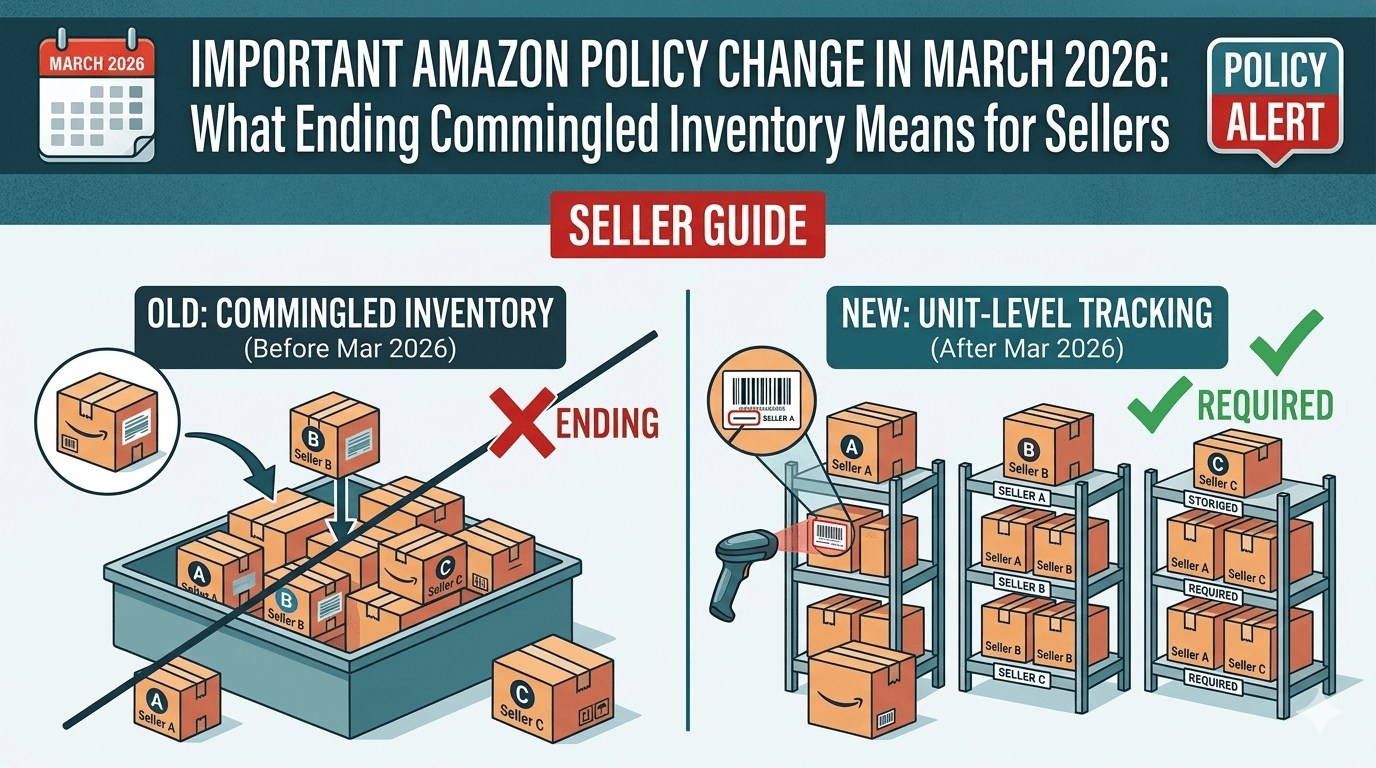
The end of commingled inventory, effective March 31, 2026, is the second type.
On the surface, it reads like a logistics and compliance update: sellers must now label inventory with Amazon-specific barcodes, inventory pools are being separated by seller account, and the longstanding practice of mixing identical products from multiple sellers in shared fulfillment stock is ending. For sellers who’ve been using FNSKU labels already, the immediate operational impact is minimal.
But the policy’s significance extends beyond labeling requirements. It represents Amazon making a deliberate choice about what kind of marketplace it wants to be — and that choice has implications for every seller regardless of whether their current labeling practices are already compliant.
Understanding what commingling was, why Amazon is ending it, and what the post-commingling marketplace looks like is what allows sellers to respond strategically rather than just operationally.
What Commingled Inventory Was and Why Amazon Built It
Commingling — formally called stickerless inventory — was a system Amazon introduced to optimize fulfillment speed. The logic was straightforward: if multiple sellers were offering the same product, identified by matching UPC or EAN barcodes, Amazon could pool all of those units together in its fulfillment network and ship whichever unit was physically closest to the customer when an order was placed.
From Amazon’s operational perspective, this was elegant. Delivery speed improved because the fulfillment decision was based on proximity rather than seller-specific inventory location. Warehouse management was simplified because identical products could be treated as fungible regardless of which seller account they were associated with. Amazon’s ability to deliver quickly across its marketplace improved without requiring dedicated seller-specific inventory placement.
From the participating seller’s perspective, commingling had real operational benefits too. Sellers didn’t need to apply individual labels to every unit before shipment — manufacturer barcodes were sufficient for the system to process inventory. This reduced prep time, reduced prep costs, and simplified the logistics of getting inventory into Amazon’s fulfillment network. For high-volume resellers selling established branded products with stable UPCs, commingling made operational sense.
The problems with commingling were less visible initially and became more significant as the system scaled.
The core structural problem was accountability. When a customer ordered a product and received a unit that came from a commingled pool, there was no reliable way to trace that specific unit to the seller whose inventory it actually came from. This created a contamination risk that operated in both directions: a seller with high quality standards could have their customers receive units from another seller’s inferior inventory, generating negative reviews on the first seller’s account for a quality problem they didn’t create. Conversely, a seller introducing counterfeit or substandard products into a commingled pool could distribute those products to customers who ordered from trusted sellers with strong review histories.
As Amazon’s marketplace scaled and the diversity of seller quality increased, these accountability problems became more consequential. Counterfeit contamination through commingled pools became a documented problem that affected brand owners, customers, and the platform’s overall trust level. Amazon’s response evolved from addressing specific incidents to restructuring the system that enabled them.
The Three Reasons Amazon Is Ending Commingling Now
Amazon’s decision to end commingling in 2026 reflects the convergence of three factors that together make the policy change both logistically feasible and strategically consistent with the platform’s direction.
The first factor is that Amazon’s fulfillment network no longer needs commingling to maintain delivery speed. When commingling was introduced, Amazon’s fulfillment center network was less geographically distributed than it is today. Shipping the nearest available unit from a commingled pool provided a meaningful delivery speed advantage over seller-specific inventory placement. Amazon’s fulfillment infrastructure in 2026 is significantly more sophisticated and geographically dense than it was when commingling was introduced. Regional distribution centers, same-day delivery facilities, and advanced inventory placement algorithms allow Amazon to deliver quickly from seller-specific inventory without requiring the proximity optimization that commingling provided. The operational justification for the system has weakened as the logistics alternative has improved.
The second factor is counterfeit and quality contamination. This is the driver that receives the most attention in Amazon’s own communications about the change, and for good reason. The commingled pool created a mechanism through which low-quality or counterfeit products could reach customers who were purchasing from sellers with high quality standards and strong review histories. Brand owners enrolled in Brand Registry and selling genuine products had no protection against their customers receiving counterfeit units from commingled inventory. The resulting negative reviews damaged the brand owner’s listing while the seller responsible for the counterfeit inventory faced no direct consequence. The accountability inversion created by commingling — where quality problems were borne by sellers who didn’t cause them — was a structural problem that grew more significant as Amazon’s counterfeit problem received more regulatory and press attention.
The third factor is Amazon’s strategic direction toward a brand-first marketplace. This factor is the one that explains why the policy change is structurally significant rather than just operationally relevant. Amazon has been systematically building tools and policies that advantage brand owners and private label sellers over generic resellers — Brand Registry, A+ content, storefront capabilities, brand analytics, and now inventory separation. Each of these changes makes brand ownership more valuable and generic reselling more operationally difficult. Ending commingling is consistent with this direction: it gives brand owners control over the inventory their customers receive, makes the customer experience traceable to the specific seller, and raises the operational bar for resellers who were previously able to participate in Amazon’s fulfillment network with minimal infrastructure.
The Specific Changes Taking Effect March 31, 2026
The policy changes that take effect with the end of commingling are worth understanding precisely, because the impact varies significantly based on a seller’s current business model and enrollment status.
For resellers — sellers offering branded products under existing UPCs without Brand Registry enrollment — the change is most significant. These sellers must now apply Amazon-specific FNSKU barcodes to every unit before shipment to Amazon’s fulfillment centers. Manufacturer barcodes — UPC, EAN, ISBN — are no longer sufficient for inventory tracking in the post-commingling system. Every unit must be uniquely identified as belonging to a specific seller account, which requires individual labeling of every product unit.
Amazon’s official FBA barcode requirements documentation outlines the complete labeling specifications, exemption criteria, and compliance requirements that sellers need to verify against their specific account and product situation before the deadline.
This labeling requirement creates real operational costs for high-volume resellers. The time required to apply FNSKU labels to every unit, either in-house or through a third-party prep center, represents a cost that didn’t exist under commingling. For sellers operating on thin wholesale or arbitrage margins, this cost increase has direct impact on profitability per unit and may make previously viable product sourcing decisions uneconomical at current price points.
For brand owners enrolled in Brand Registry with the appropriate account role, the change is operationally less disruptive. These sellers retain the ability to use manufacturer barcodes for their own products — products they manufacture or source exclusively — because those barcodes uniquely identify products that only they are selling. The key difference from the old system is that even with manufacturer barcodes, their inventory is now maintained separately from other sellers’ inventory rather than being pooled. The benefit of commingling — faster fulfillment through pooled inventory — is removed, but so is the risk — counterfeit contamination through that same pool.
The deadline’s application to inventory arrival rather than shipment is an important operational detail. The policy applies when inventory arrives at Amazon’s fulfillment centers, not when it leaves the seller’s supplier or prep facility. Sellers who ship inventory in March that arrives after March 31 must ensure that inventory is compliant with the new requirements. This means sellers cannot use the shipment timing to grandfather non-compliant inventory through the transition — any inventory entering the fulfillment network after the deadline must meet the new standards regardless of when it was shipped.
Non-compliance consequences are real rather than theoretical. Amazon has indicated that non-compliant inventory can be marked as defective, that listings can be delayed or blocked pending compliance resolution, and that additional fees or tracking complications can result from inventory that doesn’t meet the new labeling standards. Sellers who treat the March 31 deadline as approximate rather than firm are taking on risk that manifests as concrete operational and financial costs.
Who Gets Hit the Hardest: The Reseller Impact in Detail
The seller profile most significantly affected by this change is the reseller — sellers using online arbitrage, retail arbitrage, or wholesale sourcing models to offer existing branded products on Amazon without owning those brands.
For these sellers, the end of commingling creates several simultaneous operational challenges that compound each other.
Labeling infrastructure is the most immediate requirement. Every unit must now have an FNSKU label applied before it enters Amazon’s fulfillment network. For sellers who previously relied on stickerless commingling to avoid this requirement, building or accessing labeling infrastructure is an immediate cost. Options include in-house labeling — which requires time, equipment, and process discipline — or third-party prep centers — which add a per-unit cost that must be factored into margin calculations for every product.
Supply chain complexity increases for sellers whose current model involves purchasing products and shipping directly to Amazon without an intermediate prep step. The insertion of a labeling requirement into the supply chain means that a prep step is now mandatory, which adds time and cost to every shipment cycle. For sellers operating on rapid turnover models where speed from purchase to Amazon fulfillment was a competitive factor, this additional step slows the cycle in ways that affect the economics of the model.
Margin pressure is the cumulative effect of the operational changes. The labeling cost, the prep center cost or in-house prep time, the potential need to renegotiate with suppliers to accommodate prep steps — all of these add costs that weren’t present under commingling. For resellers operating on the thin margins characteristic of competitive arbitrage and wholesale categories, the margin compression from these additional costs can make previously viable sourcing decisions unviable at current price points.
The sellers most severely impacted are those who’ve been operating high-volume, low-margin reselling operations under the assumption that commingling would remain available as a cost-reducing operational feature. The end of commingling removes a structural cost advantage that made their model work, and replacing it requires either operational investment that their margins may not support or a fundamental rethinking of their business model.
Who Benefits: The Private Label and Brand Owner Advantage
The same policy change that creates operational difficulty for resellers creates meaningful structural advantages for private label sellers and brand owners, and the nature of those advantages extends beyond the immediate labeling question.
Counterfeit protection is the most immediate benefit. Under commingling, brand owners had no reliable protection against counterfeit or inferior quality units entering their inventory pool. A third-party seller introducing counterfeit versions of a brand’s product into the commingled pool could distribute those counterfeits to customers who ordered from the legitimate brand, generating negative reviews on the legitimate brand’s listing. The brand owner had no control over this because the commingled pool was managed by Amazon’s system rather than by the individual seller’s inventory.
With inventory separation, every unit a customer receives from a brand owner’s listing comes from that brand owner’s specific inventory. If a customer receives a substandard product, the source is traceable. If a counterfeit enters the marketplace, it does so through a specific seller’s account rather than through a shared pool that affects all sellers of that product simultaneously. Brand owners gain the inventory control that the commingling system made impossible.
Review integrity improves as a direct consequence of inventory separation. Negative reviews generated by counterfeit or inferior products from commingled inventory were a persistent problem for brand owners with strong genuine products. These reviews didn’t reflect the brand’s actual product quality but appeared on the brand’s listing because the customer received a unit from the commingled pool rather than from the brand’s own inventory. Inventory separation means that the reviews a brand’s listing receives reflect the actual experiences of customers receiving that brand’s actual products — a direct improvement in the accuracy and fairness of the review system for brand owners.
Competitive positioning improves for brand owners relative to resellers of their own products. Under commingling, a reseller of a brand’s products — potentially selling inferior versions or simply operating with lower quality control standards — could have their inventory intermixed with the brand owner’s own inventory, exposing the brand owner’s customers to products the brand didn’t control. Inventory separation removes this competitive hazard, giving brand owners more complete control over the customer experience associated with their listing.
The operational advantage for brand owners who retain manufacturer barcode eligibility — avoiding the FNSKU relabeling requirement — represents a real cost differential compared to resellers who must now label every unit. This cost differential widens the margin gap between brand-owned private label selling and reseller models, making private label economics relatively more attractive.
The Strategic Signal: What This Change Tells Us About Amazon’s Direction
Individual policy changes are often most meaningful when understood as signals of direction rather than just as individual requirements. The end of commingling is more informative as a directional signal than as an isolated policy.
Amazon has been systematically moving toward a brand-first marketplace for several years. The trajectory is visible across multiple developments: Brand Registry providing brand owners with enhanced tools and protections, A+ content allowing brand owners to create listing experiences that generic resellers can’t replicate, enhanced brand analytics giving brand owners customer behavior data that resellers don’t access, Project Zero and Transparency programs providing anti-counterfeit protection for enrolled brands, and now inventory separation removing the commingled pool that allowed reseller inventory to contaminate brand owner listings.
Each of these changes makes brand ownership more valuable and generic reselling more operationally difficult. The direction is consistent enough that sellers should treat it as a reliable trend rather than a series of unrelated decisions: Amazon is systematically increasing the advantage of brand ownership within its marketplace while increasing the operational cost and complexity of generic reselling.
This trend has practical implications for sellers at every stage. Sellers currently operating reselling models should evaluate whether the operational costs and competitive trajectory of those models make long-term sense given Amazon’s systematic movement away from supporting them. Sellers already operating private label businesses should recognize that Amazon’s policy direction is consistently working in their favor and invest accordingly in the brand development that amplifies those policy advantages. Sellers who are undecided between models should factor Amazon’s structural direction — not just the current economics — into their decision.
The end of commingling is one step in a longer journey. Understanding the journey is what allows sellers to position themselves for where the marketplace is heading rather than just where it is today.
Inventory Management After Commingling Ends
The end of commingling creates a specific inventory management challenge that’s worth addressing directly: without the pooled inventory buffer that commingling provided, each seller’s inventory position in the fulfillment network needs to be managed more carefully.
Under commingling, a seller’s effective available inventory at any given fulfillment center included not just their own units but the units of other sellers in the commingled pool. This created a buffer against stockouts that was invisible in the seller’s own inventory tracking but real in terms of order fulfillment reliability. With inventory separation, each seller’s fulfillment capability is entirely dependent on their own inventory position across Amazon’s fulfillment network.
This means stockout risk increases for sellers who were relying — consciously or not — on the commingled buffer to smooth out regional inventory imbalances. A seller who previously had five units of a product at a specific fulfillment center, but whose customers in that region were being served by commingled inventory from other sellers with larger regional allocations, will find that their five units need to serve their entire regional demand without that buffer.
The response to this change requires more attention to inventory placement across Amazon’s fulfillment network, more careful monitoring of days-of-stock remaining at the individual product level, and more conservative reorder triggers to ensure that stockouts don’t occur during the period when inventory is in transit to fulfillment centers. Sellers accustomed to the implicit buffer that commingling provided need to build explicit inventory buffers into their replenishment planning to compensate for its removal.
This inventory management adjustment applies to all sellers transitioning away from commingling, but it’s particularly relevant for sellers in seasonal or trend-sensitive categories where demand can spike unexpectedly and where the commingled buffer previously provided some protection against temporary stockouts during demand spikes.
Practical Steps for Sellers Responding to the Change
The action items that the policy change requires vary by seller type, but a structured response process applies across seller profiles.
Confirming your current inventory status should happen first. Are you currently using commingled inventory or have you already been using FNSKU labels? Sellers who haven’t been tracking this should check their shipment settings in Seller Central, where the barcode preference for each product is set. Understanding your current position is the prerequisite for understanding how much operational change the policy requires.
For resellers who have been using commingled inventory, establishing a labeling workflow before the deadline is the most time-sensitive operational task. Options for labeling include in-house labeling at the point of receiving inventory, having suppliers apply FNSKU labels before shipment, or using third-party prep centers that handle receiving, labeling, and forwarding to Amazon. Each option has different cost structures and lead time implications that should be evaluated against the specific product mix and volume profile.
For brand owners, confirming Brand Registry enrollment status and the specific account role associated with that enrollment is worth doing explicitly rather than assuming. The eligibility to continue using manufacturer barcodes is tied to specific enrollment criteria that should be verified rather than assumed based on approximate understanding of the requirements.
Supply chain review should accompany the labeling workflow decisions. If labeling is being added as a step in the supply chain, the timeline implications need to be factored into reorder calculations. The additional prep time adds to the total replenishment cycle, which means reorder points need to be adjusted to account for the longer time between order placement and inventory availability in Amazon’s fulfillment network.
Compliance verification for all incoming shipments after the deadline should be treated as a standard operating procedure rather than a one-time check. The deadline applies to inventory arrival, and shipments that arrive after March 31 must be compliant regardless of when they were initiated or labeled. Building compliance verification into the shipment approval process prevents non-compliant inventory from entering the network and incurring the penalties that Amazon has indicated will apply.
Frequently Asked Questions About the Commingling Policy Change
If I’ve already been using FNSKU labels, do I need to do anything differently?
For most sellers who are already using FNSKU labels, the operational change is minimal. Your inventory has been seller-specific rather than commingled, so the end of commingling doesn’t change how your inventory is handled. The main thing to verify is that your labeling practice applies consistently across all SKUs and that there are no products in your catalog where you’ve been relying on manufacturer barcodes and commingling without realizing it.
Can I have Amazon label my products instead of doing it myself?
Yes. Amazon’s FBA Label Service applies FNSKU labels to products for a per-unit fee. This option is available for sellers who don’t want to manage the labeling process themselves or through a third-party prep center. The per-unit fee needs to be factored into margin calculations — for high-volume, low-margin products, it may affect whether specific SKUs remain economically viable.
What happens to inventory that’s already in Amazon’s fulfillment network when the deadline passes?
Amazon’s communications have indicated that the policy applies to new inventory entering the fulfillment network after the deadline. Existing inventory already in fulfillment centers before March 31 is handled based on the policy framework that was in place when it was received. Sellers should verify the specific treatment of existing inventory through Seller Central communications and Amazon’s official policy documentation, as the handling of transitional inventory can vary.
Does this affect my ability to sell on multiple Amazon marketplaces?
The policy change applies to Amazon’s US fulfillment network and the specific inventory programs governed by these rules. Other Amazon marketplaces may have different timelines or requirements for equivalent policy changes. Sellers operating across multiple Amazon marketplaces should verify the specific requirements for each marketplace rather than assuming the US policy applies universally.
Is there any advantage to moving toward private label as a result of this change?
The policy change makes the economics of private label relatively more attractive compared to reselling by increasing the operational costs and complexity of the reselling model while maintaining the advantages that brand ownership provides. For sellers who were already considering a transition toward private label, the policy change reinforces the long-term case for that transition. For sellers committed to reselling models, the policy change is an operational challenge to manage rather than a prompt to change business models — but the broader trend of Amazon’s policy direction is worth factoring into longer-term business model planning.
Final Thought: The Marketplace Is Deciding What It Wants to Be
Amazon’s end of commingled inventory is best understood not as a logistics policy but as a marketplace philosophy statement. Amazon is choosing quality accountability over operational convenience, brand protection over pooled efficiency, and traceable customer experiences over anonymous inventory distribution.
These choices favor a specific type of seller — one who owns their brand, controls their inventory quality, and builds long-term customer relationships rather than optimizing for short-term throughput. They make Amazon’s marketplace more demanding for sellers who don’t fit that profile and more advantageous for sellers who do.
The sellers who will navigate this transition most successfully are the ones who understand that the policy change is a signal about direction, not just a requirement to manage in isolation. Amazon is building toward a marketplace where brand ownership is the primary organizing principle of competitive advantage. Sellers who position themselves within that framework — by building brands, by controlling inventory quality, by investing in the customer experience from first impression through post-purchase — are moving in the same direction Amazon is moving.
That alignment tends to compound over time as Amazon continues releasing policies that reinforce the brand-first direction. The sellers on the right side of that direction find each new policy change relatively manageable because they’ve already built the foundation the policies are designed to reward.
If you’re an Amazon seller working through the implications of this policy change and want to understand how it fits into your broader business strategy, you can explore how we work with sellers at ecommate.co.uk.
This article reflects analysis of Amazon’s commingled inventory policy change based on available documentation as of May 2026. Policy details and enforcement specifics are subject to change. Sellers should verify current requirements through official Amazon Seller Central communications and documentation before making operational decisions.