There’s a big difference between selling a product and building a brand.
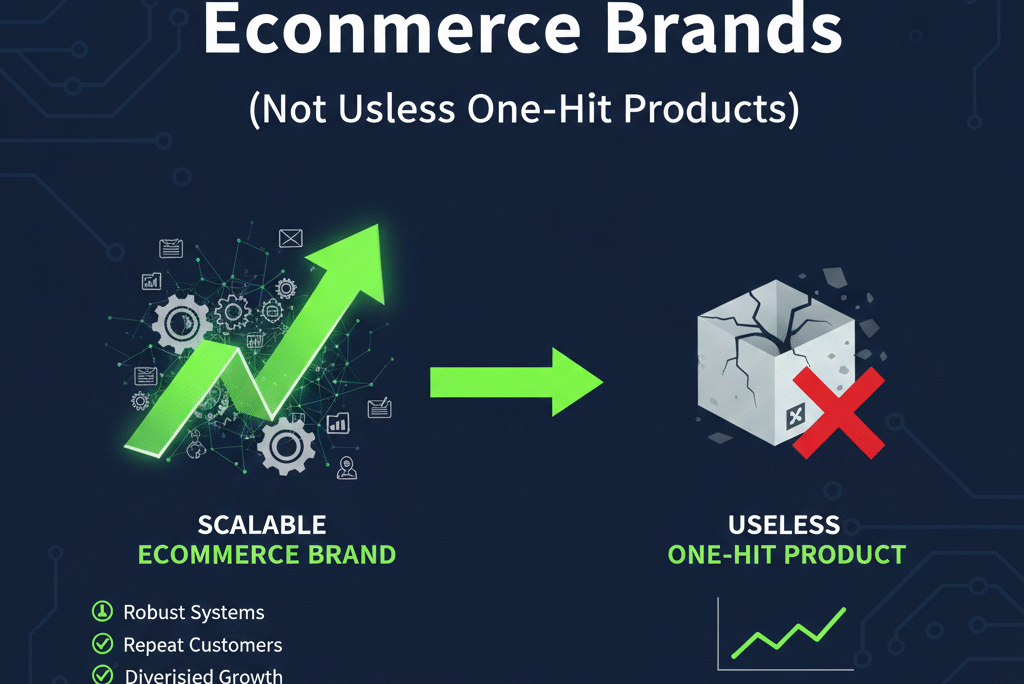
A product can spike. A brand compounds.
We’ve all seen it: someone launches a trending item, rides the algorithm wave, posts screenshots of revenue on Instagram… and six months later, silence. The listing tanks. Competitors copy it. Ads get expensive. Margins shrink. The “business” was really just a temporary arbitrage opportunity.
That’s not what we build.
We build ecommerce brands designed to survive platform shifts, algorithm changes, rising ad costs, and the inevitable wave of copycats. Not one-hit products. Not short-term hacks. Brands.
Here’s how that actually works.
Step 1: We Start With Market Depth, Not Just Product Demand
Most people begin with “What’s trending?”
We begin with “What problem space has long-term demand?”
There’s a difference.
A trending product is often seasonal, hype-driven, or dependent on social virality. A strong brand foundation sits inside a category with stable search demand, repeat purchase potential, and room for differentiation.
When we build for platforms like Amazon Private Label, eBay Private Label, or Etsy Private Label, we don’t just check search volume. We analyze:
- Is this niche saturated with generic sellers?
- Are customers complaining in reviews?
- Are listings poorly branded?
- Is there space to build perceived value?
If the only competitive advantage is price, it’s not scalable. It’s a race to the bottom.
Scalable brands win on positioning, not discounts.
Step 2: We Validate Profit Margins Before Emotion Enters the Room
Emotion is the silent killer of ecommerce.
Founders fall in love with products. We fall in love with margins.
Before anything moves forward, we break down:
- Manufacturing costs
- Shipping and logistics
- Platform fees
- Advertising projections
- Return rates
- Long-term scalability costs
Revenue screenshots mean nothing if profit margins collapse once PPC (pay-per-click ads) scale. A product that looks exciting at 40% margin can become terrifying at 18%.
Scalable brands are built on healthy contribution margins from day one. That margin is what funds ads, expansion, and survival during slow seasons.
No margin, no moat.
Step 3: We Build a Brand Identity Before the First Sale
This is where most sellers skip steps.
They source a product, slap on a logo, upload a listing, and hope keywords carry them.
That’s not branding. That’s labeling.
Brand identity is strategy. It answers:
- Who are we for?
- Why should customers care?
- What emotional position do we occupy?
- What visual language communicates that instantly?
Our Graphic Design & Brand Identity process isn’t about “making it look cool.” It’s about clarity and consistency. Colors, typography, packaging design, tone of voice — all aligned.
Because here’s the truth: customers don’t compare you to the cheapest option. They compare you to the most credible-looking option.
Branding increases conversion rates, improves perceived value, and reduces price sensitivity. That’s not theory — it’s buyer psychology.
And psychology scales.
Step 4: We Design Listings to Convert, Not Just Rank
SEO matters. But traffic without conversion is expensive noise.
On Amazon, ranking gets you visibility. Branding and structure get you sales.
We build listings around:
- Clear benefit-driven headlines
- Visual storytelling through infographics
- Objection handling inside bullet points
- Social proof integration
- Conversion-focused image sequences
The goal isn’t stuffing keywords. It’s reducing friction.
When someone lands on your listing, they’re asking silent questions:
“Is this legit?”
“Why is this better?”
“Will this solve my problem?”
“Is this worth the price?”
We answer those questions before doubt grows.
Scalable brands obsess over conversion rate because even a 1% increase compounds massively at scale.
Step 5: We Engineer Launches, Not Hope for Them
A product launch isn’t “list it and pray.”
We prepare.
Inventory timing, PPC structure, early review strategies, keyword positioning, pricing strategy — all aligned.
Early momentum signals to the algorithm that this listing deserves attention. Without that push, even good products can stall.
We design launch campaigns to:
- Generate controlled traffic
- Test keyword clusters
- Identify winning creatives
- Optimize ad spend quickly
The first 30–60 days determine long-term positioning. Done correctly, the product builds ranking stability that lowers future ad dependency.
Done incorrectly, you’re forever paying to stay visible.
Step 6: We Think Multi-Platform From the Start
One-hit sellers depend entirely on one marketplace.
Scalable brands diversify intelligently.
A strong product on Amazon can expand to eBay with adjusted pricing strategies. Certain categories perform better on Etsy when positioned correctly. A branded Shopify site builds long-term asset value and customer ownership.
We design brands that aren’t trapped.
Each platform has its own algorithm, culture, and customer behavior. The branding remains consistent. The execution adapts.
This creates resilience.
If one channel slows, others carry momentum.
That’s how brands survive algorithm updates and policy shifts.
Step 7: We Build Owned Assets — Not Just Marketplace Revenue
Marketplaces are rented land.
Your website is owned property.
When we build websites for ecommerce brands, it’s not just for aesthetics. It’s for control.
An optimized website allows:
- Email list building
- Retargeting control
- Direct customer relationships
- Brand storytelling beyond listing constraints
- Higher lifetime value
Marketplace customers are transactional. Brand customers are relational.
Owned traffic through SEO compounds over time. Paid ads stop when budgets stop. Organic visibility keeps working.
That’s long-term leverage.
Step 8: SEO & GEO — Future-Proof Visibility
Search is changing.
Traditional SEO still matters. Keyword targeting, structured content, optimized pages — all essential.
But we’re also entering the era of generative search engines. GEO (Generative Engine Optimization) prepares brands to appear in AI-driven search environments.
What does that mean practically?
Clear entity signals.
Authority-building content.
Topical relevance.
Strong brand mentions across the web.
Brands that invest in visibility today position themselves for tomorrow’s search behavior shifts.
One-hit sellers don’t think about this. Scalable brands do.
Step 9: Data Guides Decisions — Not Ego
Every scalable brand shares one trait: disciplined decision-making.
We track:
- Conversion rates
- Click-through rates
- ACoS and TACoS
- Repeat purchase behavior
- Refund patterns
- Customer feedback themes
When data signals an issue, we adjust.
When data supports expansion, we scale.
Ecommerce isn’t about guessing. It’s about testing, measuring, refining.
Emotion builds hype. Data builds empires.
When it comes to making decisions at scale, raw data matters more than assumptions. Tools like our SQP-STR Combo Analyzer help connect search term data with real performance metrics, allowing you to identify which keywords actually drive revenue — and which ones are just wasting budget.
👉 https://ecommate.co.uk/tool-box/sqp-str-combo-analyzer/
Step 10: We Plan the Second Product Before the First One Peaks
One-hit sellers chase the next trend.
Scalable brands expand inside their ecosystem.
If Product A succeeds, what naturally complements it? What deepens the brand’s authority in that niche?
Expansion increases:
- Average order value
- Cross-selling opportunities
- Brand recognition
- Customer retention
Instead of constantly acquiring new customers for unrelated products, we strengthen the brand’s category dominance.
This is how small brands become category leaders.
The Real Difference: Long-Term Thinking
Building scalable ecommerce brands requires patience.
It’s less glamorous than viral spikes.
It’s more powerful than temporary wins.
We don’t chase hype cycles.
We build positioning.
We don’t depend on luck.
We engineer structure.
A one-hit product is a transaction.
A scalable brand is an asset.
An asset grows.
An asset survives.
An asset can be sold, expanded, or passed on.
And that’s the ultimate difference.
Because when you build a brand correctly — with strategy, margin discipline, identity clarity, multi-platform strength, SEO leverage, and data-driven scaling — you’re not just launching products.
You’re building something that compounds.
Revenue is exciting.
Equity is powerful.
Scalable brands create both.
Building a scalable ecommerce brand requires more than a product idea—it takes structured research, strong branding, smart platform execution, and long-term visibility strategy. If you’re ready to move beyond one-hit experiments and build something designed to grow, our team at Ecommate can help. Explore our full range of ecommerce services and see how we turn product ideas into sustainable, profitable brands.
One of the key ingredients to turning an ecommerce business into a scalable brand is strong search visibility outside of marketplace walls. Getting inbound links from reputable sources not only helps your SEO but also drives referral traffic and builds domain authority — a crucial part of long-term growth that most one-hit sellers overlook. For actionable tactics on how ecommerce brands can effectively build high-quality backlinks and strengthen their SEO foundation, this guide on ecommerce link building strategies explains the most reliable techniques publishers and experts use to improve authority and visibility online.