Valentine’s Day is one of the most reliable revenue windows on the Amazon calendar — and one of the most consistently underexploited by sellers who treat it as a minor seasonal blip rather than a concentrated buying event with its own psychology, timeline, and buyer behaviour patterns.
Here’s what the data looks like: the National Retail Federation consistently reports Valentine’s Day as one of the top five consumer spending events of the year in the US, with Americans spending approximately $24 billion on the holiday in recent years. Average spend per person celebrating runs around $185–$192. What makes this particularly significant for Amazon sellers is that a meaningful proportion of that spend flows through Amazon — because Valentine’s Day shoppers are convenience-driven in a way that even Christmas shoppers aren’t. There’s no family gathering to shop around. It’s a single recipient, a single purchase decision, often made under time pressure, frequently by someone who isn’t a confident gift buyer.
That combination — compressed timeline, high purchase intent, uncertain buyer, convenience-seeking behaviour — is an environment where well-prepared Amazon listings dramatically outperform poorly prepared ones. The seller who updated their imagery, refined their A+ Content, structured a thoughtful bundle, and set up targeted advertising in January is operating in a fundamentally different position to the seller who noticed Valentine’s Day was approaching in the first week of February and scrambled.
This guide walks through exactly what to do, in what order, and why each element works — not as a checklist to skim, but as a strategy to actually understand and execute.
Understanding the Valentine’s Day Buying Window (And Why Timing Is Everything)
Before getting into tactics, it’s worth being precise about the timeline, because Valentine’s Day has a buying curve that’s different from Christmas or Prime Day — and misunderstanding that curve leads to misallocating preparation and advertising spend.
The Valentine’s Day buying window on Amazon effectively opens around the last week of January, when the first intentional shoppers start searching. These are the planners — people who know what they want, have budget allocated, and are looking for the best option rather than the fastest delivery. This is a small audience but a high-converting one, and it’s the audience most likely to leave reviews, favourite products, and purchase from a listing because of what it says rather than because there were no alternatives left.
The main buying wave runs from approximately February 1st through February 10th. This is the bulk of the transaction volume — buyers who are motivated and intentional but not yet under delivery pressure. They’re comparing options, reading reviews, evaluating gift suitability. Listings that clearly communicate “this would make a great Valentine’s gift” in their imagery, copy, and A+ Content capture disproportionate share during this window.
The urgency wave hits around February 11th through 13th. These buyers are no longer comparing — they’re deciding. Delivery speed becomes a primary filter. “Arrives before February 14” is a dominant search modifier during this period, and listings that are Prime-eligible and clearly displaying early delivery dates have a significant conversion advantage. Ad bids spike during this period because category competition peaks; sellers who haven’t established visibility before this window will find paid acquisition expensive and less efficient.
February 14th still generates sales — Amazon’s same-day and next-day delivery capabilities mean genuine last-minute buyers can convert — but these are primarily digital products, gift cards, and items with guaranteed immediate delivery.
The practical implication: preparation needs to be complete by January 20th at the latest for sellers who want to participate in the full buying window, not just the panic phase.
Refreshing Product Images for Valentine’s Day: What to Actually Change
The advice to “refresh your images seasonally” is easy to give and rarely explained with enough specificity to be actionable. Here’s what seasonal image refreshing for Valentine’s Day actually means in practice.
The Main Image Stays Focused on the Product
Amazon’s main image requirements are specific: white background, product clearly visible, no additional graphics or text overlaid. This isn’t where seasonal creativity happens. The main image should remain your strongest product representation — the clearest, most accurately lit, best-composed shot of what the buyer is going to receive.
What can evolve in the main image for Valentine’s Day: the styling choices within those constraints. If your product is photographed with props — and many categories benefit from contextual props — the props can shift to reference Valentine’s gifting context without violating Amazon’s requirements. A journal photographed with a pen in November can be photographed with a pen and a ribbon in January. A skincare product photographed against a neutral background in November can use a subtly warm-toned neutral in February. These are small changes, but they affect whether the thumbnail reads as “current and relevant” or “generic and evergreen.”
Secondary Images Are Where Seasonal Storytelling Happens
The secondary image slots (positions two through seven in most categories, plus video) are where Valentine’s Day framing should be concentrated.
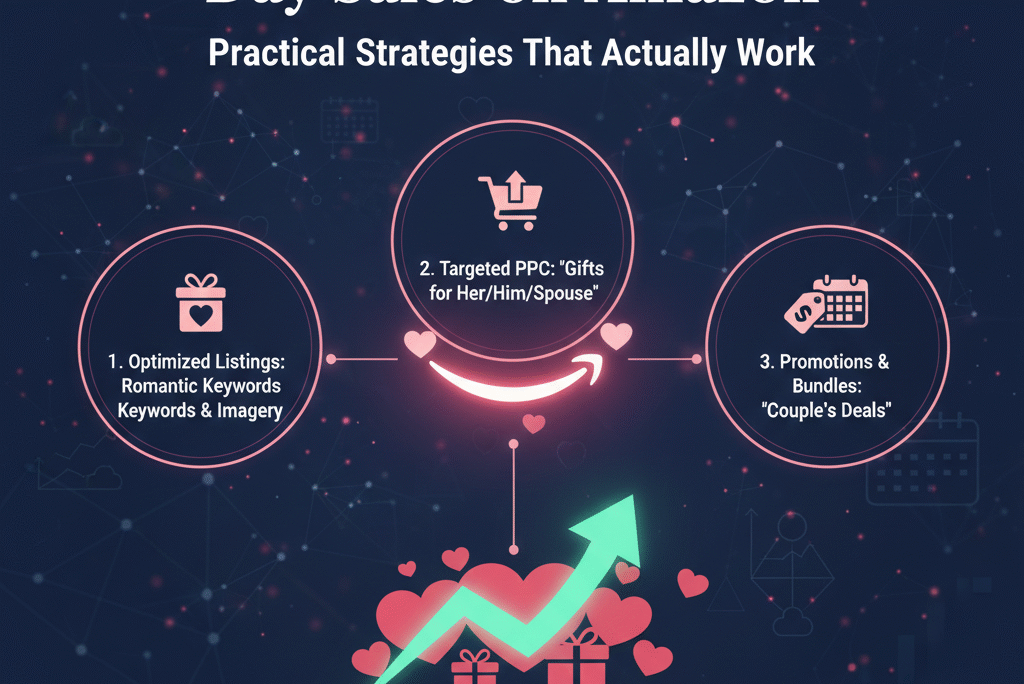
The gifting shot. A secondary image showing the product as a gift — packaged, ribboned, presented, alongside a gift card or flowers — directly answers the question the Valentine’s Day buyer is asking: does this work as a gift? You don’t need professional gift wrapping or expensive staging. A simple, well-lit shot of the product in a gift-appropriate presentation, with a subtle Valentine’s colour palette (deep reds, blush pinks, warm golds, or their more sophisticated alternatives like burgundy, dusty rose, and champagne), communicates gift-suitability immediately.
The lifestyle shot for the occasion. A secondary image showing the product in a Valentine’s Day context — on a dinner table, beside a bouquet, in a romanticised home setting — places it mentally in the occasion for the buyer. This shot is more about emotional association than information. It’s the image that makes a buyer think “yes, this fits that moment.”
The “for him/her/them” framing shot. Valentine’s buyers are frequently buying for someone else, and they’re often uncertain about gift suitability for a specific recipient. An image with subtle typography — “For the partner who has everything” or “The gift that actually lasts” — addresses that uncertainty directly and can dramatically improve the conversion rate of browsers who are interested but undecided.
The A+ Content Valentine’s module. If you have Brand Registry and A+ Content enabled, the A+ section is where you should invest the most seasonal effort. Amazon’s A+ Content allows brand-registered sellers to add rich media, comparison charts, and narrative sections to product detail pages. For Valentine’s Day, the most effective A+ modules are: a gifting narrative section that frames the product as an occasion-appropriate gift, a “why this gift works” comparison or feature layout, and a lifestyle imagery block that places the product in a romantic context. A+ Content has been shown to increase conversion rates by 3–10% on average according to Amazon’s own data — during a high-competition seasonal window, that improvement is significant.
Updating Images Without Losing Momentum
A concern some sellers have about updating listing images is disrupting accumulated performance data. This concern is usually overstated. Amazon’s algorithm adjusts to new image performance data relatively quickly — if the new image drives better CTR than the old one, the listing quality score improves. The risk of keeping underperforming images through Valentine’s Day is higher than the risk of updating to stronger ones.
Practical approach: update secondary images first (which carry no risk to the primary image’s established performance), then evaluate whether the main image needs a seasonal variation. Make changes no later than January 20th so there’s adequate time for the updated images to generate performance data before the main buying window.
Curating Your Brand Store for Valentine’s Day Gift Shoppers
If you have a Brand Store, Valentine’s Day is one of the clearest use cases for why Brand Stores exist — and most sellers underuse them during seasonal windows.
Valentine’s Day shoppers who land on a Brand Store have already crossed the threshold of brand interest. They’re not just evaluating a product; they’re evaluating whether your brand is one they want to make a gift purchase from. The Brand Store’s job is to remove friction from that decision and increase the probability that they buy more than one thing.
Build a Valentine’s Day Collection Page
A dedicated Valentine’s Day sub-page or featured collection within your Brand Store serves multiple functions. It consolidates your most gift-appropriate products in one browsable space, which reduces the cognitive load on a buyer who is open to options but doesn’t want to evaluate your entire catalogue. It signals that you’re present and prepared for the occasion, which builds buyer confidence. And it provides a landing page for Valentine’s Day-specific advertising campaigns that delivers a coherent seasonal experience rather than dropping paid traffic on a generic product page.
The collection doesn’t need to be large. Three to eight products, curated thoughtfully, with gift-suitability as the primary selection criterion, is more effective than a comprehensive product dump that asks the buyer to do the curation work themselves.
Structure Collections Around Gift Recipients, Not Product Categories
This is the difference between a Brand Store that converts during Valentine’s Day and one that doesn’t. Buyers during gift shopping occasions don’t think in product categories — they think in terms of the person they’re buying for.
“For Her,” “For Him,” “For Your Partner,” “Gifts Under £30,” “Last-Minute Gifts That Don’t Look Last-Minute” — these are frames that match the buyer’s mental model. They make the selection process feel guided and intentional rather than navigational. They also make buyers feel understood, which is a subtle but real trust signal that affects purchase probability.
If your brand sells across multiple product types, segmenting by recipient and occasion within the Brand Store is one of the most effective merchandising decisions you can make for Valentine’s Day. If your product range is narrow, the collection page itself provides sufficient structure.
Feature Bundles Prominently in the Brand Store
If you’ve created Valentine’s Day bundles (discussed in the next section), the Brand Store is the right place to feature them prominently. Bundles perform better with supporting visual context — buyers need to see what’s in the bundle, understand why those products belong together, and feel that the combination represents a coherent gift concept. The Brand Store’s richer content format supports this communication better than a single listing page does.
Creating Gift Bundles That Actually Sell
Valentine’s Day is structurally ideal for product bundles — buyers are motivated by gift-giving convenience, willing to pay a modest premium for a curated combination, and looking for something that feels complete and thoughtful without requiring them to shop multiple times.
But bundles done carelessly cause more problems than they solve. Amazon’s bundling policy exists, compliance matters, and a suppressed listing during peak Valentine’s season is a costly mistake.
Amazon’s Bundling Policy: What You Need to Know
Amazon’s bundle policy requires that bundles be composed of complementary items that provide additional value together and are sold as a single unit. The key restrictions: bundles cannot include products from different brands unless you’re the manufacturer of all included items, bundles must be clearly labelled as bundles, and the main product in the bundle should determine the category the listing appears in.
For private label sellers who manufacture all their products, bundling across your own product range is straightforward. For sellers mixing their private label products with other brands — including packaging materials, gift wrapping, or complementary items from third parties — the compliance picture is more nuanced and worth reviewing carefully before listing.
What Makes a Valentine’s Day Bundle Genuinely Convert
The best Valentine’s Day bundles have three characteristics: the products are genuinely complementary (they’re used together, or they form a coherent experience together), the combination saves the buyer decision effort (they don’t need to go elsewhere to complete the gift), and there’s a clear value proposition relative to buying the products individually.
Examples of effective Valentine’s Day bundle structures for common Amazon categories:
Skincare and personal care: A serum, a moisturiser, and a face mask that form a coherent skincare routine. The buyer isn’t just getting products — they’re getting a gift that communicates “I care about your self-care.” The gift-routine framing does a lot of the purchase justification work.
Food and beverage: A curated combination of complementary products — two coffee varieties and a mug, a tea assortment and an infuser, a hot sauce collection — that creates a themed experience rather than just a quantity of items. The “experience” framing increases perceived value.
Fitness and wellness: A resistance band set, a foam roller, and a workout guide, presented as a home gym starter kit. The “kit” framing is inherently gift-appropriate and provides the buyer with a clear value proposition.
Home and kitchen: A set of complementary items — matching kitchen utensils, a spice collection with a rack, coordinating home organisation products — that create a visual and functional ensemble. Gift sets in home categories perform particularly strongly because they solve the “I don’t know their taste” uncertainty by presenting a curated aesthetic rather than a single item.
Pricing Bundles for Valentine’s Day
Bundle pricing should offer a modest incentive relative to individual item prices — not a deep discount, but a small saving (5–10%) that makes the bundle feel like a value decision rather than an upsell. The primary value proposition of a Valentine’s bundle isn’t price — it’s convenience and completeness. Price the bundle accordingly: at a point where it represents clear value, but where the margin on the bundle is similar to or better than the margin on individual items given the reduced per-transaction fulfilment friction.
Amazon Advertising for Valentine’s Day: A Specific Strategy
“Use Amazon ads” is advice that ranges from obvious to useless depending on how it’s implemented. Valentine’s Day advertising on Amazon has specific characteristics that reward a deliberate approach and punish improvised spending.
Start Campaigns Before the Buying Window Peaks
The most common Valentine’s Day advertising mistake is starting campaigns too late. Sellers who launch Valentine’s campaigns in the first week of February are entering an auction that’s already competitive, with listings that haven’t had time to accumulate the fresh CTR and conversion data that the algorithm uses to calibrate organic ranking. Campaigns launched in mid-January operate in lower-competition conditions, generate early performance data that feeds listing quality signals, and are positioned to capture the planning-phase buyers who often have higher intent than the urgency-phase buyers who dominate late-February ad spend.
Practical approach: Launch Valentine’s-specific campaigns January 13th–15th. Start with moderate bids and let the performance data accumulate. Increase bids progressively from February 1st as competition grows, with the largest bid adjustments in the February 8–13 window when buyer intent is highest.
Build Campaigns Around Gift-Intent Keywords, Not Just Category Keywords
Valentine’s Day creates a search behaviour shift that many sellers don’t fully account for in their keyword strategy. Buyers who are purchasing for themselves search differently from buyers who are purchasing as a gift. The gift-intent search adds modifiers — “Valentine’s gift for [recipient type],” “gift for [interest/hobby],” “thoughtful gift ideas [category],” “romantic gift [descriptor]” — that represent high-converting queries during the Valentine’s window but are largely irrelevant the rest of the year.
Building a dedicated Valentine’s Day campaign targeting gift-intent keywords — separate from your evergreen category campaigns — allows you to capture this intent pattern without contaminating your year-round keyword performance data. These campaigns should be paused after Valentine’s Day and archived for review when planning the following year.
Effective Valentine’s gift-intent keyword categories:
- “Valentine’s gift for [her/him/partner/wife/husband/boyfriend/girlfriend]”
- “Romantic gift [product category]”
- “[Product category] gift set”
- “Valentine’s Day [product category]”
- “Gift for [relevant hobby or interest]”
- “Last minute Valentine’s gift”
Run these alongside your standard category campaigns, not instead of them. Buyers searching with explicit gift intent are a subset of the total Valentine’s audience — many buyers who are gift shopping still use standard category search terms.
Use Sponsored Brands to Amplify the Store Experience
If you’ve built a Valentine’s Day Brand Store collection (as discussed above), Sponsored Brands ads that link directly to that collection page are one of the highest-returning ad types for the holiday. The buyer who clicks a Sponsored Brand ad and arrives at a curated Valentine’s Day gift collection is already in a more purchase-ready mental state than the buyer who lands on a single product page. The Brand Store page does more conversion work, which means the paid click is worth more.
Sponsored Brands video ads showing the product in a Valentine’s context — being gifted, being opened, being used by a couple or alongside a romantic occasion — outperform standard image ads during the February window because the visual context aligns with the buyer’s mental model of the occasion.
Track What’s Actually Driving Sales, Not Just What’s Driving Clicks
One of the most important Valentine’s Day advertising disciplines is understanding the difference between keywords that generate impressions and clicks, and keywords that generate actual purchases. During a high-intent seasonal window, the temptation is to increase spend broadly — but broad spend increases often inflate metrics without improving the underlying efficiency of what’s already working.
The SQP-STR Combo Analyzer connects search query performance data with actual sales outcomes, helping you identify which search terms are genuinely converting during the Valentine’s window versus which are generating spend without proportional return. Using this kind of analysis during and after the Valentine’s period gives you the data to optimise spend in real time and to build a better-informed campaign structure for the following year.
Review Strategy During the Valentine’s Window
Reviews are one of the primary conversion factors for Valentine’s Day buyers — and they affect it differently than reviews affect everyday purchases.
A Valentine’s Day shopper evaluating an unfamiliar product as a gift is reading reviews with a specific question in mind: did this work as a gift? They’re looking for evidence that other buyers bought it as a gift, that the recipient was pleased with it, and that the product delivered on its promise. A listing with 200 reviews that include phrases like “bought this as a Valentine’s gift,” “she loved it,” “perfect for a couple,” or “great gift idea” converts dramatically better in this context than a listing with 200 reviews focused purely on product performance and durability.
You can’t solicit specific review content — Amazon’s review policy prohibits directing buyers toward particular sentiments. But you can use Amazon’s Request a Review feature to ensure that every buyer from the January and early February period is reminded to leave feedback. The review content you collect from seasonal purchasers naturally includes gift context language because those buyers’ experience of the product is inherently gift-focused.
Respond to existing reviews that mention Valentine’s Day or gifting to signal to prospective buyers that you’re an attentive seller — this response appears publicly and contributes to the overall impression of the listing.
Pricing and Promotions: How to Structure Incentives Without Racing to the Bottom
Valentine’s Day creates pressure to discount — competitors are running promotions, buyers are comparison shopping, and the impulse is to undercut on price to capture volume. Resisting this impulse strategically, rather than reflexively, is one of the characteristics of high-margin Valentine’s performance.
The buyers who are price-sensitive to the point of defaulting to the cheapest option are typically not the highest-converting Valentine’s Day buyers. The buyer purchasing a thoughtful gift for someone they care about is less price-sensitive than the buyer purchasing a commodity product for themselves — provided the listing communicates the value that justifies the price.
What works better than straight discounts:
Percentage-off promotions with a minimum order threshold can increase average order value without reducing margin per unit unnecessarily. “10% off when you buy two” converts well during Valentine’s season because it aligns with the “gift for both of us” purchase logic that couples often use.
Amazon coupons (the small orange badge visible in search results) provide a visible price incentive signal in search results without requiring a structural price reduction. The visual signal of a coupon in the search result thumbnail increases CTR, which improves listing quality score — an indirect but real SEO benefit of the promotion mechanism.
Lightning Deals during the February 10–13 window, when urgency-phase buyers are most active, can create significant short-term volume spikes for products with sufficient inventory. Lightning Deals require advance submission to Amazon’s promotions system, so the planning needs to happen in January.
Post-Valentine’s Day: The Data You Should Be Collecting Now
The sellers who consistently improve their Valentine’s Day performance year over year are the ones who treat the post-holiday period as a strategic analysis window rather than a period to mentally close the book and move on.
The data available in the 72-hour window after Valentine’s Day — while it’s still fresh in the algorithm and visible in your analytics — is some of the most valuable you’ll collect all year.
Review what the search term report reveals about which keywords actually drove conversions. Not which keywords drove clicks — which ones drove purchases. The difference between the two is often significant and reveals which buyer intent patterns your listing captured effectively versus which ones it appeared for but failed to convert.
Compare the performance of your seasonal images against their predecessors. If you have A/B testing enabled through Amazon’s Manage Your Experiments tool, you have direct data on which image approach converted better. If not, the CTR data during the Valentine’s window versus the pre-Valentine’s period gives you directional evidence of whether the seasonal refresh was effective.
Identify which products performed unexpectedly well as gifts. Sometimes a product that you don’t consider particularly gift-oriented performs strongly during Valentine’s season because buyers discovered a use case you hadn’t fully marketed toward. Review language during the Valentine’s window often reveals these unexpected use cases — and they’re worth building into your year-round positioning if the gifting angle appears repeatedly.
Note which bundle combinations generated the most interest. If you ran multiple bundle configurations, the relative performance of each is a direct signal about which product combinations buyers find most compelling as gifts. This informs both next year’s Valentine’s bundle strategy and potentially your year-round product development.
Document the advertising performance data before making post-holiday campaign changes. The keyword, bid, and campaign structure data from the Valentine’s window is most valuable when reviewed intact. Export the search term reports, note the bid levels that were active during peak performance periods, and archive this alongside your notes for next year’s planning.
Building a Valentine’s Day Timeline That Actually Works
Translating all of the above into a specific, actionable timeline:
Early January — 3 to 4 weeks before peak shopping:
Finalise which products to prioritise for Valentine’s Day. Photograph or update secondary images with seasonal styling. Update A+ Content with Valentine’s gifting modules. Create or update the Brand Store Valentine’s collection page. Finalise bundle configurations and ensure compliance with Amazon’s bundling policy. Submit Lightning Deal applications to Amazon for the February 10–13 window.
January 15–20 — Campaign launch:
Go live with Valentine’s Day advertising campaigns targeting gift-intent keywords. Start bids conservatively and let performance data accumulate. Activate Brand Store Sponsored Brand campaigns. Enable coupons on priority listings.
February 1 — Main buying window opens:
Begin incrementally increasing bids on best-performing keywords. Monitor search term reports daily to identify high-converting queries and add them to exact-match campaigns. Confirm inventory levels are sufficient for the full buying window.
February 7–10 — Peak buying period:
Maximum bid levels on highest-performing campaigns. Ensure Prime delivery badges are displaying correctly. Confirm that “Arrives before February 14” guarantee dates are accurate for your fulfilment timescale. This is the period where listing quality and advertising efficiency matter most.
February 11–13 — Urgency phase:
Focus advertising on Prime-eligible listings with confirmed rapid delivery. Buyers in this window are filtering heavily by delivery speed. Non-Prime listings are significantly less competitive during these final days.
February 15–28 — Post-holiday analysis:
Pull all search term reports, review performance against benchmarks, identify what worked and what didn’t. Document findings for next year’s planning. Begin planning inventory and creative refresh for Mother’s Day, which follows roughly 90 days later.
Frequently Asked Questions
When is too late to start preparing for Valentine’s Day on Amazon?
If it’s after January 20th, you’re already behind for the full opportunity — but not out of it. A seller who updates imagery and launches advertising in late January can still capture the main buying wave (February 1–10) effectively. By February 5th, the ability to rank organically for gift-intent keywords through advertising alone becomes much harder, and the urgency phase (February 11–13) is dominated by sellers with established listing quality scores. Even a partial preparation is better than none — prioritise the main image quality and targeted advertising over comprehensive Brand Store overhauls if time is short.
Do Valentine’s Day image updates affect my year-round listing performance?
They can, in both directions. A seasonal image that performs better than the original during the Valentine’s window will improve listing quality score, which has residual positive effects on ranking. A seasonal image that performs worse — perhaps because it’s too occasion-specific to convert outside the Valentine’s context — should be reverted after February 14th. The safest approach is to update secondary images (leaving the main image intact) for the seasonal period, then revert after the holiday. This limits the risk of disrupting established main image performance data.
Is Valentine’s Day relevant for products that aren’t traditionally gift categories?
More often than sellers expect. Any product that creates an experience, that connotes care or indulgence, or that a buyer might purchase for their partner’s benefit can be positioned as a Valentine’s gift with appropriate framing. Kitchen accessories, fitness equipment, home organisation products, personal care items, stationery, books, hobby supplies, tech accessories — these are all categories where buyers actively seek Valentine’s gift options. If your product category has any reasonable connection to an experience a couple might share or a quality of life improvement a buyer might give their partner, Valentine’s Day positioning is worth testing.
How much should I increase advertising spend for Valentine’s Day?
There’s no universal answer — it depends on your category competitiveness, your baseline advertising efficiency, and your inventory depth. A practical approach: increase total Valentine’s advertising budget by 30–50% relative to a typical January week, allocated primarily toward gift-intent keywords and Brand Store campaigns. Monitor daily spend efficiency carefully and be willing to reduce spend on underperforming keywords rather than increasing bids on everything equally. The sellers who overspend on Valentine’s advertising typically do so by raising bids on broad match keywords that generate clicks from both gift-intent and everyday-use buyers — paying peak seasonal CPCs for audiences that would have found the listing anyway.
What happens to Valentine’s Day listings after February 14th?
Remove or archive Valentine’s-specific imagery, update A+ Content back to your standard evergreen version, and pause Valentine’s-specific advertising campaigns (don’t delete them — the historical keyword and performance data is valuable for next year). Return listings to standard year-round presentation within one to two days of the holiday. Leaving seasonal content live after the occasion reads as neglect to buyers in the post-holiday period and can subtly undermine the year-round brand impression.
Final Thoughts on Valentine’s Day
Valentine’s Day on Amazon rewards the sellers who treat it as a distinct commercial event with its own buyer psychology, its own timeline, and its own preparation requirements — not as a minor seasonal variation on their standard approach.
The sellers who capture the most from this window aren’t necessarily the ones with the most products, the highest advertising budgets, or the largest existing review base. They’re the ones who prepared early enough to position themselves for the planning-phase buyers, whose imagery communicates gift-suitability clearly enough to stop a scroll in a competitive thumbnail grid, and whose listings reduce buyer uncertainty at the conversion point rather than leaving questions unanswered.
None of the tactics above are complicated. What makes them effective is executing them together, in the right sequence, early enough for the algorithm to reward the preparation rather than just record it.
Amazon’s seasonal selling guidance points sellers in the right direction — but guidance and execution are different things. Seasonal success on Amazon compounds for sellers who build systematic preparation into their annual calendar, use each year’s data to improve the next year’s approach, and treat holidays like Valentine’s Day as repeatable opportunities rather than annual scrambles.
If you want support turning seasonal opportunities into consistent, scalable growth — from listing optimisation and brand identity to advertising strategy and long-term Amazon brand building — explore our Amazon Private Label Services to see how we work with sellers at every stage.