This is for people who are tired of YouTube videos that declare one model “the best” while conveniently selling a course about it. Each of these three models works. Each of them has real costs that rarely get mentioned upfront. This comparison covers both.
Why Most Ecommerce Model Honest Comparisons Are Useless
Search “private label vs wholesale vs dropshipping” and you’ll find the same comparison repeated across hundreds of articles and videos with minor variations. Dropshipping is presented as the beginner-friendly entry point. Wholesale is framed as the stable middle ground. Private label is positioned as the serious, long-term play.
The framework isn’t wrong. But the way these comparisons get presented almost universally glosses over the specific, practical costs of each model — the things that actually determine whether a seller succeeds or fails — in favor of a clean narrative that supports whatever the content creator is selling.
This comparison takes a different approach. Each model is examined for what it actually delivers, what it actually costs, and who it actually suits — including the parts that tend to get minimized in promotional content. The goal is an honest assessment that lets a seller make a genuinely informed decision rather than one based on a curated version of reality.
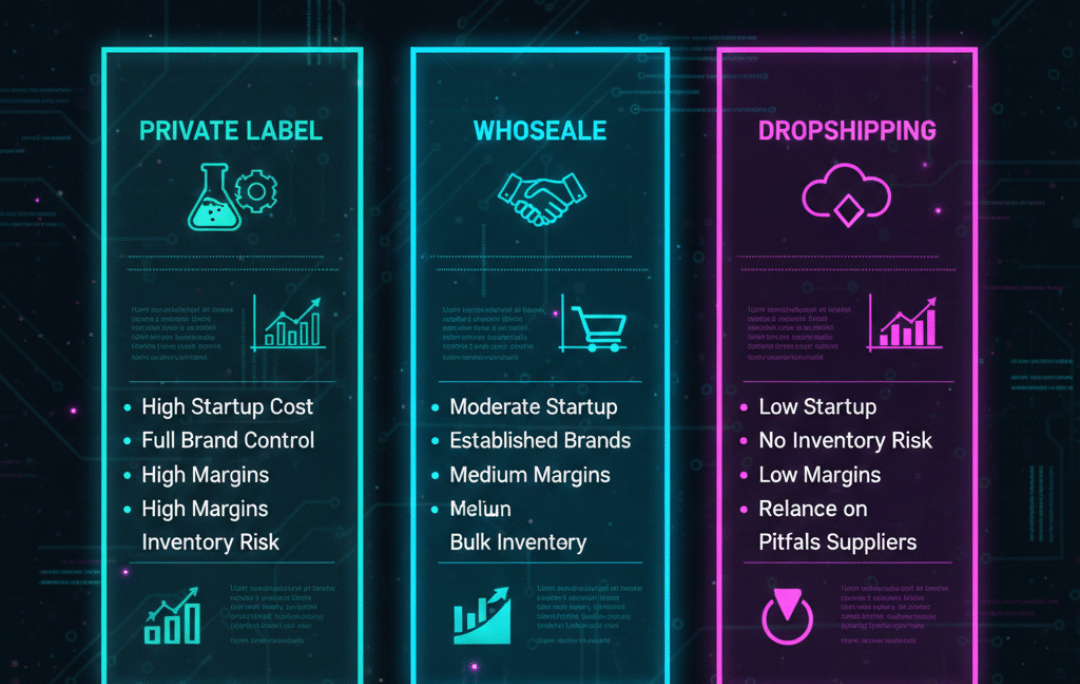
The core distinction is simple enough to state in one sentence, and everything else flows from it: dropshipping means you don’t own the product, wholesale means you resell someone else’s brand, and private label means you build your own. Every difference in risk profile, margin structure, scalability, and long-term value traces back to that single distinction.
Dropshipping: What It Actually Is and What It Actually Delivers
Dropshipping is the model where a seller lists products for sale without holding inventory. When a customer places an order, the seller purchases the item from a third-party supplier who ships it directly to the customer. The seller never touches the product. They never hold stock. Their capital exposure at any given moment is theoretically minimal.
For a complete technical breakdown of how the model is structured operationally, Shopify’s guide to dropshipping covers the mechanics thoroughly — what follows here focuses specifically on what the model delivers and where it falls short as a long-term business foundation.
This structure makes dropshipping genuinely attractive as an entry point into ecommerce, and that attraction is legitimate rather than just well-marketed. The ability to test products, platforms, and audiences without committing to inventory gives new sellers something genuinely valuable: the ability to learn through real experience without the risk of being stuck with unsold stock.
The learning that dropshipping enables — understanding how product pages convert, how advertising platforms work, how customer service issues arise and get resolved, how pricing affects buyer behavior — is real and transferable. Sellers who spend six to twelve months running a dropshipping operation before transitioning to a more capital-intensive model typically make better decisions in that transition because they’ve developed intuition through actual experience rather than theory.
That’s the legitimate case for dropshipping. It’s worth stating clearly because dismissing the model entirely, as some private label advocates do, ignores the genuine educational value it provides.
What the promotional version of dropshipping consistently understates is the operational reality of running it as a sustainable business rather than as a learning exercise.
Product quality is entirely outside the seller’s control. When a supplier sends a substandard product, the customer complaint arrives in the seller’s inbox. The seller’s rating suffers. The seller’s account metrics deteriorate. The supplier faces none of these consequences. This asymmetry — full accountability for outcomes that result from decisions the seller can’t make — is a structural problem with the model that no amount of supplier vetting fully resolves.
Shipping speed is a permanent competitive disadvantage against established platforms and merchants. Customers whose baseline expectation is set by Amazon Prime delivery are not patient about ten to twenty-five day shipping windows from overseas suppliers. Return rates are higher, review scores are lower, and customer acquisition costs are elevated because the product experience doesn’t match the purchase experience that competing options provide.
Product differentiation is essentially impossible. When a dropshipping seller finds a product that converts well, the competitive response is immediate and predictable — dozens of other sellers list the same product, often from the same supplier, and the price compression that follows erodes the margin that made the product attractive in the first place. There is no moat. There is no brand equity. There is no accumulated advantage that makes the business more defensible over time.
The honest summary of dropshipping: it is a testing model that provides genuine educational value and very limited long-term business value. Some sellers do scale dropshipping operations successfully, but they typically do so by solving specific operational problems — building proprietary supplier relationships, developing genuine product curation expertise, operating in niches with limited competitive response — that go well beyond the basic model. For the majority of sellers, dropshipping is where ecommerce education happens, not where durable businesses get built.
Wholesale: The Model That’s More Complicated Than It Looks
Wholesale sits in the middle of the three models in almost every dimension: more capital required than dropshipping, less than private label; more operational stability than dropshipping, less brand equity than private label; more predictable revenue than dropshipping, less scalable margin than private label.
The model works like this: a seller purchases branded products from authorized distributors or directly from brands at wholesale prices, then resells them on Amazon, eBay, Walmart, or other platforms at retail prices. The seller is not creating anything new. They are competing on logistics efficiency, pricing strategy, and platform optimization within an existing brand’s ecosystem.
The appeal of wholesale to analytically-minded sellers is legitimate. The products being sold already have proven demand — you’re not guessing whether buyers want this item, because the brand’s sales history answers that question. Customers already trust the brand whose products you’re selling, which reduces the trust-building burden that new private label brands face. Listing optimization is less complex because the product’s search relevance is established. The research required before committing capital is more straightforward than private label’s multi-month evaluation process.
For sellers who want to build cash flow reliably while developing operational competence — inventory management, platform optimization, logistics coordination — wholesale provides a functional environment to do that. The predictability of selling established products has real value, particularly for sellers who are scaling operations and need revenue consistency to fund growth.
The structural problems with wholesale become visible as sellers try to grow beyond a certain point, and they’re worth understanding before committing to the model.
Pricing control is absent by design. When multiple sellers are authorized to sell the same product, competition on price is the primary competitive lever available. This creates the race-to-the-bottom dynamic that characterizes most wholesale categories on Amazon — sellers progressively reduce prices to win the buy box until margins compress to the point where the economics of the operation barely justify the capital and labor involved. The seller with the lowest cost structure wins, which is usually the seller with the most scale, which is usually not the seller who just entered the category.
Brand relationships are fragile in ways that aren’t obvious until they break. A brand can restrict authorized resellers, change distributor agreements, introduce minimum advertised price policies, or begin selling directly on Amazon — all of which can eliminate or severely damage a wholesale seller’s revenue from that product line with limited notice. Sellers who have built their business around a handful of key brands discover that their revenue is less owned than rented when one of those brand relationships changes.
Margins in wholesale are structurally limited. The difference between wholesale cost and retail price has to cover the seller’s Amazon fees, advertising spend, storage costs, and profit margin. In competitive categories, this math frequently produces margins in the five to fifteen percent range after all costs, which requires significant volume to generate meaningful absolute profit. Volume requires capital. Capital requires either profit reinvestment or external financing. The scaling constraint becomes capital-intensive in ways that can feel like running faster just to stay in place.
The honest summary of wholesale: it is a viable model for building predictable revenue and operational competence, and a limited model for building long-term brand equity or defensive competitive position. The business you build through wholesale is real, but it’s not uniquely yours — the moment the brand relationships that underpin it change, the business changes with them.
Private Label: What the Model Actually Requires
Private label is the model where a seller sources a product — typically from a manufacturer who also supplies other brands — customizes it with their own branding, packaging, and positioning, and sells it under their own brand name. The physical product may be similar or identical to products sold by competitors sourcing from the same or comparable factories. The brand, the positioning, the customer relationship, and the accumulated equity are entirely the seller’s own.
This distinction — owning the brand rather than the product — is what makes private label both more demanding and more valuable than the other two models. The demand comes from the upfront investment in research, branding, and launch. The value comes from the compounding effect of brand equity, pricing power, and customer loyalty that the investment builds over time.
The case for private label as a long-term business model rests on several structural advantages that the other models don’t provide.
Margin structure is fundamentally different. Private label sellers who have established a brand with genuine positioning can price at premiums that wholesale and dropshipping sellers cannot access, because they’re not competing on a commodity product against sellers with identical inventory. Twenty-five to sixty percent gross margins — after product cost, shipping, and Amazon fees but before advertising — are achievable in established private label categories in ways that the other models simply don’t support. Those margins create the financial flexibility to invest in advertising, product development, and brand building that compounds over time.
Competitive defensibility builds gradually but becomes real. A private label brand with a thousand genuine reviews, strong visual identity, established positioning, and a loyal customer base is not easily displaced by a new entrant with a cheaper product. The new entrant has to build what the established brand already has, which takes time and money that the established brand is not waiting idle while they spend. The moat is not impenetrable, but it’s real in ways that the other models don’t create.
Exit value is a dimension of private label that most sellers don’t think about until much later than they should. A well-built Amazon private label brand — with consistent revenue, strong review profile, coherent brand identity, and documented operational processes — is a sellable asset. The market for acquiring Amazon brands is established and active. Multiples of three to six times annual profit, sometimes higher for particularly defensible brands, represent a liquidity event that wholesale and dropshipping businesses can rarely access at comparable valuations because they lack the brand equity that acquirers are paying for.
Platform optionality is greater for private label than for the other models. A private label brand can sell on Amazon, on eBay, on its own Shopify store, through wholesale partnerships with retail buyers, and through whatever new platforms emerge over the coming years. The brand travels. The inventory can be deployed wherever buyers are. A dropshipping operation is platform-dependent by definition. A wholesale operation is brand-relationship-dependent. A private label brand owns its own positioning and can adapt to changing platform environments in ways the other models can’t.
The honest accounting of private label’s costs is equally important to state clearly, because the promotional version of the model minimizes them in ways that set up sellers for disappointment.
Upfront capital requirements are real and significant. A first private label product done properly — covering manufacturer samples, initial production order, professional photography, brand and packaging design, and launch advertising — typically requires somewhere between five and fifteen thousand dollars minimum, with many products requiring more. Sellers who launch with less than this usually find themselves unable to sustain the advertising spend necessary for early visibility or to reorder before a stockout disrupts momentum.
Time to profitability is longer than the other models. A dropshipping store can generate revenue within days of launch. A wholesale operation can generate cash flow within weeks. A private label product typically requires three to six months from product research to launch, followed by another three to six months of optimization and brand building before the economics stabilize at a profitable level. Sellers who need immediate income should understand this timeline before committing to the model.
Research and execution quality determine outcomes more directly in private label than in the other models. A wholesale seller who picks a suboptimal product can pivot to another product quickly. A private label seller who picks a suboptimal product after months of research and thousands of dollars of investment faces a much more consequential pivot. The upfront investment in getting the product and market selection right is not optional — it’s the primary determinant of whether the business works.
Margin Reality: What the Numbers Actually Look Like
Margin comparisons between the three models are frequently presented in best-case terms that don’t reflect typical seller experience. The realistic ranges are worth stating honestly.
Dropshipping margins before advertising are often cited at ten to thirty percent. After accounting for the advertising costs necessary to generate traffic in competitive dropshipping niches, effective margins frequently compress to single digits or turn negative during periods of high competition or ad cost volatility. The theoretical margin and the operational margin are often very different numbers.
Wholesale margins of five to fifteen percent represent the range after Amazon fees and product cost, before advertising. In highly competitive wholesale categories where multiple authorized sellers are actively competing for the buy box, effective margins can compress below five percent. Wholesale operations that generate acceptable returns typically do so through volume — high order quantities, efficient logistics, and multiple SKUs that collectively produce adequate absolute profit even at thin percentage margins.
Private label margins of twenty-five to sixty percent represent the range for established products in competitive but not hypercompetitive categories, after product cost, Amazon fees, and shipping but before advertising. The advertising cost required to maintain visibility while a product is scaling reduces effective margins significantly during the launch and early growth phases. Established products with strong organic rankings can achieve effective margins — after advertising — that approach or exceed the theoretical range. New products with heavy advertising dependency operate at much lower effective margins until organic ranking stabilizes.
The margin comparison that matters most for decision-making is not the theoretical margin at a single point but the trajectory over time. Dropshipping margins tend to compress as competition enters successful products. Wholesale margins tend to compress as category competition intensifies. Private label margins tend to expand as brand equity accumulates, organic ranking strengthens, and advertising efficiency improves. The compounding direction of private label margins is what makes the model’s higher upfront investment rational over a multi-year horizon.
Risk Profile: Where Each Model Is Actually Vulnerable
The common framing of dropshipping as low-risk because it requires minimal upfront capital is misleading in a specific and important way. Risk has multiple dimensions, and optimizing one dimension often increases another.
Dropshipping’s risk profile looks like this: low upfront financial risk, high ongoing operational risk. The business is vulnerable to supplier unreliability, platform policy changes, advertising cost volatility, and competitive commoditization. These risks are not hypothetical — they materialize regularly and can destroy a dropshipping operation quickly. The low entry cost doesn’t reduce these risks; it just delays the moment when capital is committed until the operational risks are already present.
Wholesale’s risk profile: medium upfront financial risk from inventory commitments, medium ongoing operational risk. The primary risks are brand relationship fragility, pricing competition, and the capital intensity of scaling. These risks are more predictable and more manageable than dropshipping’s operational risks, but they’re real constraints on the model’s long-term upside.
Private label’s risk profile: high upfront financial risk concentrated in the research, sourcing, and launch phase, lower ongoing operational risk once the product is established. The model front-loads its risk in a way that feels uncomfortable but actually concentrates the exposure in a phase where careful decision-making can substantially reduce it. A product that has been rigorously researched, carefully sourced, and well-launched carries much lower ongoing risk than a dropshipping operation that is perpetually exposed to competitive and operational disruption.
The risk framing that matters: private label feels riskier because the capital commitment comes before the revenue. But the business that results from a successful private label launch is more defensible, more predictable, and more resilient to competitive pressure than either of the other models. The risk is real; so is the reason it’s worth taking.
Scalability: What Growth Actually Looks Like in Each Model
Scaling a dropshipping operation runs into predictable problems. As order volume increases, supplier reliability becomes more critical and more variable. Customer service volume increases proportionally with sales, and in a model where product quality and shipping speed are outside the seller’s control, customer service issues tend to scale faster than revenue. Advertising costs increase as the operation scales because margins don’t improve with volume in ways that allow reinvestment, creating a ceiling on growth that many dropshipping sellers hit before they expected to.
Scaling a wholesale operation is primarily a capital problem. Purchasing more inventory at wholesale prices requires capital. The cash flow cycle — pay for inventory, sell inventory, collect revenue, repeat — requires working capital that grows proportionally with revenue. Margins don’t improve meaningfully as volume increases in most wholesale categories, which means the absolute profit generated by scaling doesn’t compound in ways that make further scaling progressively easier. The operation gets larger. The economics stay roughly the same.
Scaling a private label business has a different character. Product variants — different sizes, colors, configurations — can be added under an established brand without building brand equity from scratch for each new SKU. Complementary products that serve the same buyer can leverage the trust and recognition the original product has accumulated. Organic ranking, once established, generates traffic that doesn’t require proportional advertising spend to maintain. The customer base built around one product is an asset that new products can access at lower acquisition cost than starting from zero.
The compounding that private label enables — brand equity, organic ranking, customer loyalty, product line extension — is structurally absent from the other models. It’s the reason private label businesses can grow without the economics becoming less favorable over time, while the other models tend to face increasing headwinds as they scale.
Platform Dependency: A Risk That Gets More Important Every Year
Every ecommerce model operates within platforms, and platform dependency is a risk that all three models share. But the degree of dependency and the nature of the exposure differ significantly.
Dropshipping is among the most platform-dependent business models in ecommerce. The operation exists within the intersection of a selling platform’s rules, an advertising platform’s algorithm, and a supplier’s reliability — three separate external dependencies, any one of which can disrupt the business significantly. When Facebook changes its advertising algorithm, when Amazon changes its dropshipping policy, or when a supplier fails to fulfill orders reliably, there is no brand equity, no customer relationship, and no proprietary positioning to fall back on. The business dissolves with the disruption.
Wholesale is primarily dependent on the brands whose products are being resold. Those brands can restrict reseller access, introduce direct selling on the same platforms, or change pricing policies in ways that immediately affect the reseller’s economics. The wholesale seller has built a distribution capability but not a brand, which means they have no alternative channel when brand relationships change.
Private label has platform dependency — selling primarily on Amazon means being subject to Amazon’s rules — but the brand that private label creates can exist across multiple platforms simultaneously and can develop customer relationships that exist independently of any single platform. A private label brand with a genuine following, an email list, and a website has options when platform conditions change that the other models simply don’t have. This optionality becomes more valuable every year as platforms evolve and the value of owning the customer relationship directly becomes clearer.
Choosing the Right Model: An Honest Framework
Rather than a definitive ranking of which model is superior, the more useful framing is alignment between the model’s characteristics and the seller’s specific situation, objectives, and constraints.
Dropshipping makes sense as a starting point for sellers who are genuinely new to ecommerce, who need to develop operational intuition before committing significant capital, and who understand that the model’s value is primarily educational. Approaching dropshipping as a twelve-month learning program with limited capital exposure — rather than as a business to scale indefinitely — is the framing that extracts its genuine value without the frustration of treating it as something it isn’t.
Wholesale makes sense for sellers who want predictable cash flow, who have the capital to manage inventory commitments, who have the operational discipline to manage multiple SKUs and supplier relationships, and who are not primarily motivated by building a brand asset. It’s a legitimate business model for people whose objectives match what it actually provides — reliable revenue from an operationally intensive distribution business.
Private label makes sense for sellers who are thinking in multi-year terms, who have the capital and patience for the upfront investment and the longer path to profitability, who are motivated by building something with genuine brand equity and exit value, and who understand that the work required is substantially more demanding than the other models in exchange for substantially greater long-term upside.
The common trajectory among sellers who stay in ecommerce for several years tends to converge on private label, not because the other models are worthless but because the compounding advantages of brand ownership become increasingly apparent over time. Many sellers spend time in dropshipping and wholesale — building operational competence and accumulating capital — before making the transition to private label with the skills and resources to execute it properly.
Frequently Asked Questions
Can you do all three models simultaneously?
Technically yes, practically it’s rarely wise for sellers below a certain operational scale. Each model requires different skills, different capital allocation, and different strategic attention. Sellers who split focus across multiple models typically execute all of them below the standard of sellers who concentrate. The exception is sellers who use wholesale or dropshipping deliberately to generate cash flow that funds a private label launch — a sequential rather than simultaneous approach.
Is private label still viable for new sellers in 2026?
Yes, but the execution standard required is higher than it was in 2019 or 2020. The sellers who are successfully launching private label products today are doing more thorough market research, investing more in brand development, and operating with more operational discipline than most sellers who succeeded in the earlier period. The opportunity is genuine. The margin for casual execution is smaller.
How much money do you actually need to start each model?
Dropshipping can be started with a few hundred dollars for a Shopify store and initial advertising. Wholesale typically requires a few thousand dollars for initial inventory commitments plus platform fees. Private label done properly requires five to fifteen thousand dollars minimum for a first product, with many products requiring more depending on the category and order quantities involved.
Which model is most passive once established?
None of them are genuinely passive, despite how they’re sometimes marketed. Dropshipping requires continuous product research, advertising management, and customer service. Wholesale requires ongoing inventory management, pricing monitoring, and supplier relationship maintenance. Private label requires continuous listing optimization, advertising management, and brand development. Private label does become less operationally intensive relative to its revenue as organic ranking strengthens, but the idea of any ecommerce model running without ongoing attention is more marketing than reality.
What’s the most common mistake sellers make when choosing a model?
Choosing based on how the model is marketed rather than on an honest assessment of what it actually requires and delivers. Dropshipping gets chosen because it sounds easy. Private label gets chosen because it sounds exciting. Wholesale gets chosen because it sounds logical. The model that suits a specific seller depends on their capital, their timeline, their objectives, and their tolerance for different types of risk — none of which align neatly with which model sounds most appealing in a YouTube video.
Final Thought on Private Label vs Wholesale vs Dropshipping: The Model Is the Foundation, Not the Strategy
Every ecommerce business is built on one of these three foundations, and the foundation determines which strategies are available, which competitive positions are accessible, and what the business is ultimately worth.
Dropshipping provides a foundation for learning. Wholesale provides a foundation for cash flow. Private label provides a foundation for brand equity, pricing power, and long-term asset value.
None of these are wrong foundations. They’re different ones, suited to different objectives and different seller profiles. The mistake isn’t choosing any particular model. The mistake is choosing without honestly understanding what you’re choosing — what the model provides, what it costs, and what it doesn’t provide that you might be assuming it does.
The ecommerce sellers who build something durable over a multi-year horizon tend to be the ones who made that choice with clear eyes, committed to it fully, and executed it with the patience and discipline the model actually requires.
If you’re at the stage of evaluating which model makes sense for your specific situation and want to understand what a properly executed private label approach looks like, you can explore how we work with sellers at ecommate.co.uk.