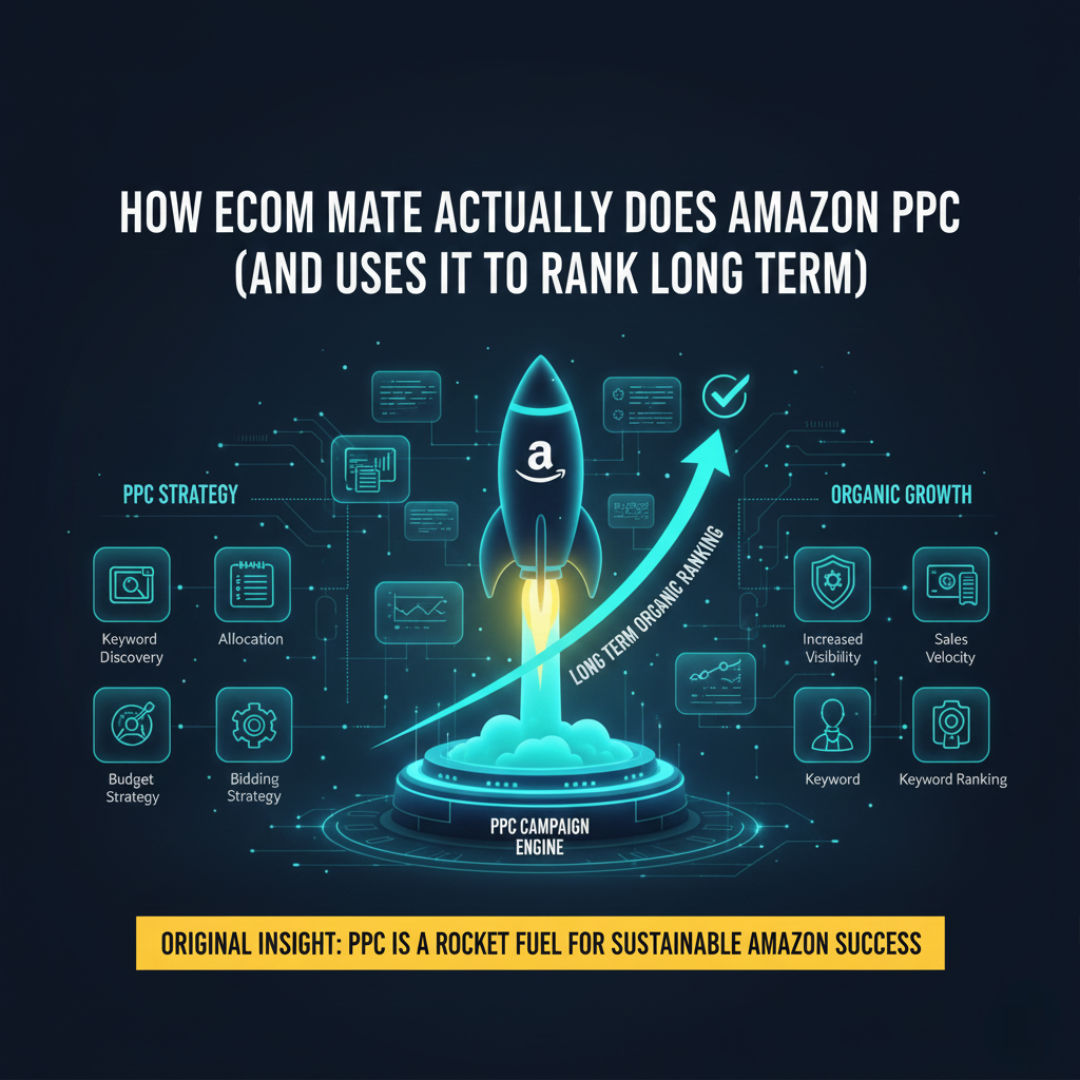
This is for Amazon sellers who are running Amazon PPC, watching ACoS fluctuate, adjusting bids based on gut feeling, and wondering why none of it seems to translate into organic ranking improvement. The problem usually isn’t the bidding. It’s a fundamental misunderstanding of what PPC is actually for. This guide will teach you how to rank on Amazon.
The Explanation That’s Convenient But Wrong
Ask most sellers what Amazon PPC is in 2026, and the answer tends to follow a familiar script: you pick keywords, you set bids, your product shows up in search results when someone searches those terms, and you watch your Advertising Cost of Sales — ACoS — to make sure the spend is generating profitable returns. Adjust bids up when performance is good, down when it’s not. Repeat.
This explanation isn’t incorrect. It describes, mechanically, what’s happening. But it’s incomplete in a way that causes a huge proportion of Amazon PPC campaigns to underperform — not because the sellers running them are doing the mechanics wrong, but because the mechanics were never the actual point.
The pattern that plays out across countless seller accounts looks like this: ads get turned on, ACoS gets watched daily, and when ACoS looks bad, bids get adjusted — often without much underlying logic beyond “this number looks too high, so I’ll lower the bid” or “sales are slow, so I’ll raise it.” Spend continues. ACoS fluctuates. Organic rankings, which is what most sellers actually care about long-term, stay roughly where they were.
The sellers who get genuinely strong results from Amazon PPC are operating from a different mental model entirely. They’re not treating PPC as an advertising tool that generates sales in isolation. They’re treating it as a system — one that exists primarily to generate the data and signals that Amazon’s algorithm uses to determine organic ranking, with sales revenue as a secondary (though still important) output along the way.
That distinction — PPC as a ranking system versus PPC as an advertising tool — is the foundation everything else in this guide builds on.
What Amazon’s Algorithm Actually Sees
To understand why PPC works the way it does, it helps to understand something about how Amazon’s ranking system processes information: it doesn’t meaningfully distinguish between paid and organic performance the way sellers do in their own mental accounting.
From a seller’s perspective, PPC sales and organic sales are different categories, one cost money directly, one didn’t. From Amazon’s algorithmic perspective, both are simply evidence of buyer behavior: did someone search for this term, see this product, click on it, and buy it?
The algorithm cares about that sequence of events, search, click, conversion, and it’s largely indifferent to whether the click came from a sponsored placement or an organic one.
Amazon’s own advertising documentation describes how Sponsored Products campaigns are evaluated on relevance and conversion signals that align directly with the factors influencing organic placement, confirming that the relationship between paid visibility and organic ranking isn’t an assumption, but a documented feature of how the system is designed to work.
This means every PPC click and conversion is generating data that feeds into the same signals that determine organic ranking: how relevant this product is to a given search term, how likely a buyer is to convert when they find it through that term, whether the price is competitive enough to convert at the rate buyers expect, and overall whether this product represents a good match for the search intent behind a keyword.
Organic ranking, left to develop on its own, builds slowly — it depends on accumulating enough organic search traffic and conversion history for Amazon’s algorithm to confidently associate a product with specific keywords. For a new listing, or a listing trying to establish relevance for new keywords, that accumulation can take a long time, during which the product remains largely invisible for the searches that matter most.
PPC compresses that timeline. By paying for visibility on specific keywords, a seller can generate the click-and-conversion data needed to establish keyword relevance much faster than waiting for organic traffic alone would allow. The “cost” of PPC, viewed this way, isn’t just the cost of the sales it directly generates — it’s also, and often primarily, the cost of accelerating the data accumulation that organic ranking depends on.
This reframing changes what “success” looks like for a PPC campaign. A campaign that’s “losing money” by ACoS standards in its early weeks might be doing exactly what it should be doing — generating the conversion data on priority keywords that will, over the following weeks and months, translate into organic ranking improvements that reduce the need for that PPC spend in the first place.
Why Most PPC Accounts Fail Before Optimization Even Begins
There’s a strong tendency among sellers to treat PPC problems as bidding problems — if a campaign isn’t performing, the instinct is to adjust bids, pause keywords, or reallocate budget. And sometimes that’s the right response. But a substantial proportion of underperforming PPC accounts have a more fundamental issue that no amount of bid adjustment will fix: the campaign structure itself doesn’t support meaningful optimization.
Campaign structure determines what data you can actually see and act on. If a single campaign contains multiple products, multiple match types, and a mix of discovery and proven keywords all blended together, the performance data that comes out of it is essentially unreadable. You can see an overall ACoS for the campaign, but you can’t isolate which specific keyword, which match type, or which product is driving that number — which means any adjustment you make is based on aggregate data that obscures what’s actually happening underneath.
The structural principles that high-performing accounts follow tend to be consistent. Each ASIN — each individual product — typically gets its own campaign, or at minimum its own dedicated ad groups, rather than being bundled with other products. This isolates performance data so that a strong-performing product doesn’t mask a weak one, or vice versa.
Match types — automatic, broad, phrase, and exact — get separated rather than combined within the same campaign. Each match type serves a different purpose and produces different kinds of data; automatic and broad campaigns are useful for discovering new keyword opportunities, while exact match campaigns are where proven, high-converting keywords get concentrated for efficient, predictable performance.
Campaigns also tend to be organized by intent — separating keywords that represent broad, top-of-funnel discovery searches from keywords that represent buyer-ready, high-intent searches close to a purchase decision. These two types of traffic behave very differently and benefit from different bidding approaches, and combining them in the same campaign makes it difficult to manage either well.
Brand and non-brand campaigns get separated as well, since defensive brand-term campaigns (protecting your own branded searches from competitors) serve a fundamentally different purpose than campaigns targeting generic category or competitor terms, and blending them obscures the performance of both.
None of this structural work is glamorous, and it doesn’t produce any immediate change in sales or ACoS on its own. But without it, every subsequent optimization decision is being made on data that’s too aggregated to be meaningfully actionable — which is why so many sellers feel like they’re “optimizing” constantly without anything actually improving.
Using PPC as a Keyword Discovery Engine
One of the most underused capabilities of Amazon PPC is its function as a research tool — specifically, automatic campaigns’ ability to reveal what search terms Amazon itself associates with a product, based on real buyer behavior rather than keyword tool estimates.
Keyword research tools are valuable, but they have a fundamental limitation: they’re estimating relevance and volume based on aggregated data across many sellers and listings, not based on how Amazon’s algorithm specifically perceives your particular product. Two products in the same category, with slightly different titles, images, or even just different accumulated review profiles, can end up being associated with somewhat different sets of search terms by Amazon’s system — and a keyword tool has no way of capturing that product-specific reality.
Automatic campaigns let Amazon’s own algorithm make these associations and then surface the results in your search term reports. Running a well-funded automatic campaign for a period of time generates a report showing exactly which search terms led to clicks and conversions for your specific listing — which is, in effect, Amazon telling you what it thinks your product is relevant for for, validated by actual buyer behavior rather than estimated by a third-party tool.
The process from there is straightforward in concept, even if it requires ongoing attention in practice. Search terms that are converting well get “promoted” — added as exact-match keywords in dedicated campaigns where they can be bid on more precisely and where their performance can be tracked cleanly. Search terms that are clearly irrelevant to the product — which happens more often than sellers expect, since automatic targeting can be imprecise — get added as negative keywords to prevent wasted spend on traffic that was never going to convert. Search terms that show some promise but aren’t yet proven get watched for a longer period before a decision is made either way.
The insight that’s easy to miss here is that some of the keywords that end up driving the most significant organic ranking improvements for a product are discovered this way — through PPC data — rather than through pre-launch keyword research. Buyer language doesn’t always match what keyword tools predict, and the gap between predicted and actual relevant search terms can be substantial, particularly for products with any degree of novelty or for categories where buyer terminology is inconsistent.
Bidding as Signal Management, Not Auction Winning
There’s a framing of PPC bidding that treats it as a competitive auction game — you’re trying to win placements against other sellers bidding on the same keywords, and the goal is to win enough auctions to generate sales while keeping your average cost per click low enough to stay profitable.
This framing isn’t wrong, exactly, but it misses what bids are actually accomplishing from a ranking perspective. A bid isn’t just a price you’re willing to pay for a click — it’s a lever that determines how much visibility, and therefore how much data, you’re generating for a specific keyword. Winning more impressions and clicks on a priority keyword means generating more conversion data on that keyword, which is what eventually feeds into organic ranking for it.
This reframing has practical implications for how bidding should be approached at different stages of a product’s lifecycle.
During a launch period, or when trying to establish ranking for new priority keywords, a higher ACoS is often not just acceptable but appropriate — the goal during this period isn’t profitability from PPC itself, it’s generating enough volume of conversion data on the right keywords to start moving organic ranking. A campaign that’s “unprofitable” by a strict ACoS standard during this period may be doing exactly its job if it’s generating the signal volume needed to establish relevance.
As a product matures and organic ranking for priority keywords improves, the calculus shifts. PPC no longer needs to carry as much of the volume on those keywords — organic traffic is now contributing meaningfully — which means bids can tighten, ACoS targets can become stricter, and the focus shifts from generating signal to protecting margin while maintaining the ranking that’s already been established.
The goal throughout isn’t “win clicks” in some abstract sense — it’s “establish and then maintain relevance” for the keywords that matter most to the business. Bidding decisions made with that goal in mind look different from bidding decisions made purely to hit a target ACoS number, especially in the early stages of a product’s life.
Budget Allocation and the Hidden Cost of Running Out of Money Mid-Day
Budget allocation across campaigns is often treated as a relatively mechanical exercise — set daily budgets based on available spend, adjust periodically based on overall performance. But how budget is allocated, and specifically whether campaigns are running consistently throughout the day versus exhausting their budget early, has consequences that go beyond the obvious “you can’t get more sales once the budget runs out.”
When a campaign exhausts its daily budget partway through the day, ads for that campaign stop showing for the remainder of the day — which means for priority keywords, there are now hours during the day where your product isn’t appearing in search results at all for searches that matter. Even if your overall ACoS for the day looks reasonable, this creates gaps in the conversion signal you’re sending to Amazon’s algorithm for those keywords during the hours your ads weren’t running.
These gaps can quietly undermine ranking momentum in ways that aren’t obvious from looking at daily performance summaries. A keyword that’s building toward an organic ranking improvement needs relatively consistent signal generation — sporadic visibility, even if the periods when ads are running show good performance, doesn’t build the same kind of consistent relevance signal as steady visibility throughout the day.
This is where budget allocation connects to a part of the business that doesn’t initially seem related to advertising at all: inventory management. Campaigns sometimes get throttled or intentionally reduced not because of a deliberate strategic decision, but because a seller is managing toward limited stock — worried about running out of inventory if PPC drives too much velocity. The unintended consequence is that ranking momentum, which depends on consistent PPC-driven signal generation, gets disrupted at exactly the time it matters most — often during a launch period or while trying to establish ranking for new keywords.
Aligning advertising spend with actual inventory runway — understanding how many days of stock remain at current and projected sales velocity, and ensuring that ad spend (and the sales it generates) is sustainable given that runway — is a planning exercise that sits upstream of bidding and budget decisions, but that significantly affects whether those decisions can actually be executed consistently. A campaign that has to be turned off mid-month because inventory ran low isn’t a bidding failure, but its effect on ranking momentum is the same as one.
When the Listing Is the Problem, Not the Ads
One of the most common and most fixable PPC issues isn’t actually a PPC issue at all: ads that are generating clicks — sometimes plenty of clicks — but not converting those clicks into sales at an acceptable rate.
When this happens, the instinct is often to adjust the campaign — change keywords, lower bids, try different match types. But if clicks are happening and conversions aren’t, the campaign is doing its job; it’s getting the product in front of interested searchers. The breakdown is happening after the click, on the listing itself.
The diagnostic questions worth asking when conversion rate from PPC traffic looks weak are largely about the listing rather than the campaign. Do the images clearly communicate what the product is and why it’s a good choice, or are they generic and unconvincing relative to competing listings the buyer is also seeing? Does the listing clearly communicate the value proposition — why this product, at this price, is the right choice — or does it leave that question for the buyer to figure out? Is the price competitive relative to what similar products are charging, or is there a mismatch between the price and the perceived value the listing communicates? Does the review profile — count, rating, recency — give buyers enough confidence, or does it create hesitation?
The reason this matters beyond just fixing an individual campaign is that listing improvements made for this reason often have outsized effects — a listing that wasn’t converting PPC traffic well also wasn’t converting organic traffic well, even if the organic traffic volume was lower and the problem was less visible. Fixing the listing doesn’t just improve the PPC campaign’s numbers; it improves the conversion rate for all traffic to that listing, which is itself one of the inputs into organic ranking.
This is part of why “bad PPC campaigns” sometimes become profitable not through any change to the campaign itself, but through listing changes made in response to what the campaign’s data revealed.
Negative Keywords: Where a Lot of Real Optimization Happens
Negative keywords don’t get the attention that bidding strategy or campaign structure get, but for accounts that have been running for a while, ongoing negative keyword management is often where a meaningful share of efficiency improvement actually happens.
The logic is straightforward: as campaigns run and search term data accumulates, patterns emerge showing which search terms are generating clicks without conversions — traffic that’s costing money without producing sales. Some of these terms are clearly irrelevant (an automatic campaign matched a search term that has only a loose semantic relationship to the product). Others are relevant to the product category broadly but represent low-intent searches — informational queries, or searches for a different price tier or use case than what this specific product serves.
Adding these terms as negatives doesn’t just save the wasted spend directly — it also has a secondary effect on the data quality for the keywords that remain. A campaign that’s spending a portion of its budget on traffic that never converts is, in effect, diluting its own performance metrics with noise. Removing that noise makes the remaining performance data — for the keywords that are actually relevant — cleaner and more reliable for making further bidding and targeting decisions.
This is ongoing work rather than a one-time setup task. New irrelevant terms surface as automatic campaigns continue running, and what counts as a low-intent term can shift over time as a product’s positioning, pricing, or competitive landscape changes. Accounts that treat negative keyword review as a regular, recurring task tend to maintain better long-term efficiency than accounts that set up negatives once at the start and never revisit them.
The Metrics That Matter Beyond ACoS
ACoS is the metric most sellers watch most closely, and it’s genuinely useful — but used in isolation, it can be actively misleading about whether a PPC strategy is working.
The reason is that ACoS measures the efficiency of ad spend relative to ad-attributed sales, in isolation. It doesn’t capture what’s happening to organic sales, which is often the actual point of the PPC investment in the first place. A campaign with an ACoS that looks high in isolation might be part of a broader picture where total sales — organic plus PPC combined — are growing, and where the PPC spend is what’s driving that organic growth.
This is where TACoS — Total Advertising Cost of Sales, calculated as ad spend divided by total sales (not just ad-attributed sales) — becomes a more useful metric for understanding overall business impact.
For sellers less familiar with how TACoS is calculated and tracked in practice, Jungle Scout’s breakdown of the metric covers the mechanics in detail — what matters for this discussion is less the calculation itself and more what a declining TACoS trend actually indicates about the relationship between PPC and organic performance.
A declining TACoS over time, even if ACoS for individual campaigns stays roughly flat, suggests that organic sales are growing as a proportion of total sales — which is exactly the dynamic you’d expect if PPC is successfully functioning as a ranking accelerator rather than just a sales channel in its own right.
Organic sales volume and trend, tracked separately from PPC-attributed sales, is similarly important — it’s the most direct evidence of whether the ranking improvements that PPC is supposed to be accelerating are actually materializing.
Keyword-level organic ranking position, tracked over time for the priority keywords that PPC campaigns are targeting, completes the picture — it’s the most direct measure of whether the specific signal-generation strategy is working for the specific keywords it’s targeting.
A campaign can look inefficient by ACoS alone while being highly successful by this broader set of metrics — and conversely, a campaign with an excellent ACoS that isn’t contributing to organic growth or ranking improvement for priority terms may be less strategically valuable than its surface-level efficiency suggests, particularly if that efficient ACoS is coming from low-volume, low-priority keywords that don’t move the needle on overall business growth.
PPC as a Temporary Push, Not a Permanent Dependency
The endpoint of using PPC as a ranking accelerator, rather than as an ongoing sales channel in its own right, is a state where PPC spend on specific keywords can be reduced — sometimes substantially — without a corresponding drop in total sales for those keywords, because organic ranking has improved enough to carry a meaningful share of the volume that PPC was previously generating.
This is the practical payoff of everything described above. For priority keywords, the sequence looks like: increase visibility and spend to generate conversion volume and signal strength, monitor organic ranking position for those keywords as signal accumulates, and as organic ranking improves and organic traffic for those keywords increases, reduce PPC spend on those keywords proportionally — testing whether total sales (organic plus remaining PPC) hold steady or grow despite the reduced spend.
When this works as intended, PPC spend for a given product, over its lifecycle, often follows a pattern of higher spend during launch and early ranking-establishment periods, followed by a meaningful reduction once organic ranking for priority keywords has stabilized — with that reduced spend then being available for either margin improvement or reallocation toward establishing ranking for additional keywords or new products.
The alternative — PPC spend that stays flat or grows indefinitely without any corresponding reduction as organic ranking (theoretically) improves — is usually a sign that the ranking improvement isn’t actually happening, regardless of what ACoS looks like. PPC, in that scenario, has become a permanent cost of maintaining visibility rather than a temporary investment in establishing it.
What This Looks Like in Practice
Walking through a realistic scenario helps connect these principles together. A product launches into a competitive category with strong product quality and a solid review profile relative to similar new launches, but with essentially no visibility — it’s new, and Amazon’s algorithm has no data yet associating it with any particular search terms.
The early phase focuses on automatic campaigns, run with enough budget to generate meaningful traffic volume, primarily for the purpose of discovering which search terms Amazon associates with this specific listing and which of those terms convert well. Over a period of several weeks, search term data accumulates, and a set of high-converting terms emerges — some expected, based on pre-launch keyword research, and some less expected, reflecting buyer language that wasn’t anticipated.
These high-converting terms get moved into dedicated exact-match campaigns, where bidding can be more precise and performance tracking is cleaner. At the same time, the listing itself gets reviewed against the conversion data — are there terms that are generating clicks but converting poorly, and if so, does the listing need adjustment to better address what buyers searching those terms are looking for?
As the exact-match campaigns for priority terms run and accumulate conversion data, organic ranking for those terms begins to shift — initially slowly, then more noticeably as the accumulated signal crosses whatever threshold Amazon’s algorithm uses to adjust ranking. Tracking organic position for these specific terms shows movement that correlates with the PPC activity, with some lag.
As organic ranking improves and organic traffic for these terms increases, PPC spend on these specific terms gets reduced — bids are lowered, or budgets are tightened — and the resulting total sales (organic plus remaining PPC) for these terms are monitored. If total sales hold steady or continue growing despite reduced PPC spend, that’s confirmation that organic ranking is now doing meaningful work that PPC previously had to do alone.
The spend that’s freed up from this reduction gets reallocated — either toward establishing ranking for additional keywords through the same process, or toward overall margin improvement if the priority keyword list has been adequately covered.
None of this involves any tactic that wouldn’t be visible to anyone looking at the account from the outside. It’s not a hack or a workaround — it’s a systematic application of the underlying logic of how PPC data feeds into organic ranking, applied consistently over time.
Frequently Asked Questions About Amazon PPC Strategy
How long does it take for PPC to start affecting organic ranking?
This varies by category competitiveness and by how much conversion volume the PPC campaigns are generating, but meaningful organic ranking shifts in response to sustained PPC-driven conversion data on specific keywords often start becoming visible over a period of several weeks to a couple of months, with continued improvement over a longer period if the signal generation continues consistently. Single-day or single-week PPC pushes are unlikely to produce lasting organic ranking changes — it’s the accumulation over a sustained period that matters.
Is a high ACoS always a bad sign?
No — and this is one of the most common misunderstandings. During a launch period, or when establishing ranking for new priority keywords, a higher ACoS can be an appropriate and even necessary part of generating the signal volume needed for organic ranking to improve. What matters is whether that ACoS is part of a strategy that’s expected to translate into organic ranking improvement (and therefore reduced PPC dependency) over time, versus an ACoS that’s simply persistently high with no corresponding organic improvement — which would suggest something in the strategy isn’t working.
Should automatic campaigns be turned off once exact-match campaigns are established for priority keywords?
Not necessarily — many accounts benefit from keeping automatic campaigns running at a lower budget on an ongoing basis, since they continue to surface new keyword opportunities as a product’s review profile, pricing, or the competitive landscape changes over time. The role of automatic campaigns shifts from primary discovery (early on, when the goal is finding the initial set of priority keywords) to ongoing discovery (later, when the goal is catching new opportunities as they emerge) — but ongoing discovery still has value.
How much budget should be allocated to PPC relative to overall revenue?
There’s no universal percentage that applies across categories and product lifecycle stages — a new launch in a competitive category may reasonably spend a much higher proportion of revenue on PPC during its early months than an established product with strong organic ranking. The more useful framing than a fixed percentage is tracking TACoS over time and watching whether it’s trending in a direction consistent with the product’s lifecycle stage — declining as a product matures and organic ranking strengthens, or appropriately elevated during an active launch or ranking-establishment phase.
What’s the most common reason PPC campaigns plateau and stop improving?
Beyond the structural and strategic issues covered throughout this guide, one of the most common practical reasons is exactly the inventory-related issue discussed earlier — campaigns getting throttled or turned off due to stock concerns, which disrupts the consistent signal generation that ranking improvement depends on. Beyond that, campaigns that never move past the “automatic campaign, broad targeting” stage — never graduating high-converting terms into dedicated exact-match campaigns — often plateau because they’re not concentrating spend and bidding precision on the keywords that matter most.
Final Thought: Amazon PPC Is the Fastest Way to Prove What Amazon Already Rewards
Strip away the mechanics, and what Amazon’s algorithm is ultimately looking for is consistent: relevance to what buyers are searching for, and consistent evidence that buyers who find a product actually want to buy it. Organic performance proves this slowly, through accumulated traffic and conversion history over time. Amazon PPC proves it quickly, by generating that traffic and conversion history on demand, for the specific keywords a seller chooses to prioritize.
Used this way — as a system for accelerating the proof of relevance and conversion that Amazon’s algorithm rewards — Amazon PPC becomes something genuinely different from an advertising expense that needs to be minimized. It becomes an investment in organic ranking, with a return that shows up not just in Amazon PPC sales themselves, but in the reduced Amazon PPC dependency and improved organic visibility that follow when the strategy works.
Used the other way — as a sales channel evaluated purely on its own immediate efficiency, disconnected from any deliberate strategy about ranking — Amazon PPC tends to do exactly what most sellers experience: it generates some sales, at some cost, indefinitely, without the underlying organic picture ever meaningfully improving.
The mechanics — bids, match types, negative keywords — are the same either way. What differs is the system they’re operating within, and whether that system is built around the actual mechanism by which Amazon’s algorithm works, or around a simplified mental model that treats Amazon PPC as just another form of advertising.
If you’re building an Amazon private label business and want your Amazon PPC strategy built as part of a system that drives ranking — not just a budget line that needs to be managed — you can explore how we approach this at ecommate.co.uk.