Thinking of launching an Amazon Private Label product?
Here’s the honest timeline:
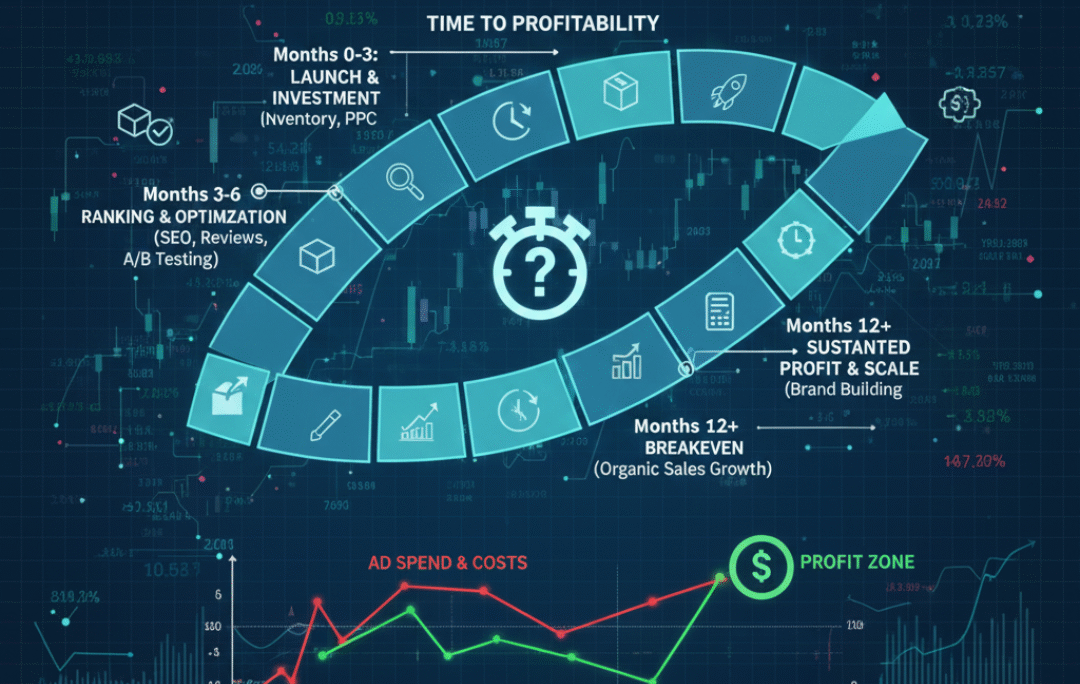
- 0–3 months: spending, no revenue
- 4–6 months: break-even (if done right)
- 6–9 months: real profit begins
Most sellers underestimate this—and that’s why they quit too early.
What “Profit” Actually Means (And Why Most Sellers Get It Wrong)
First, let’s define “profit” in Amazon Private Label (because this is where the internet cheats).
When most people say “I’m profitable,” they usually mean one of three things:
- Their product is selling
- Amazon deposited money into their bank
- Revenue > product cost
That’s not profit.
👉 That’s hope wearing a spreadsheet.
Real profit means:
You’ve paid for:
- Inventory
- Shipping
- Amazon fees
- PPC ads
- Returns and refunds
- Software tools
…and still have money left that you could withdraw without hurting the business.
If that definition made you uncomfortable—good.
You’re already ahead of most sellers.
📌 Quick Answer: Amazon Private Label Profit Timeline
- Break-even: 4–6 months
- Consistent profit: 6–9 months
- Strong profitability: 9–12 months
This assumes proper execution, sufficient capital, and no major mistakes.
How Long Does It Take to Make Money on Amazon FBA?
This is one of the most searched questions—and the answer is simple:
👉 Most sellers don’t make real money in the first 3–4 months.
Early revenue ≠ profit.
Real profit usually comes after:
- Data-driven optimization
- Review accumulation
- PPC refinement
If you’re expecting profits in weeks, you’re setting yourself up for disappointment.
The Realistic Amazon Private Label Timeline (No Fairy Dust)
Let’s walk through what actually happens for most serious sellers.
Months 0–1: Research, Setup, and Spending Money With No Dopamine
This is the “why am I doing this” phase.
You’re:
- Researching products
- Analyzing competitors
- Talking to suppliers
- Designing branding and packaging
- Setting up Seller Central
- Paying for samples
There is zero revenue here.
Only expenses.
This is normal. This is necessary. This is where impatient people quit.
If someone tells you they made money in this phase, they’re either lying or selling something.
Months 2–3: Production, Shipping, and Existential Dread
Now you’ve committed.
You’ve:
- Placed inventory orders
- Wired money overseas
- Started dealing with suppliers daily
- Learned the emotional meaning of “shipping delays”
Still no sales.
Still no revenue.
Still spending.
This phase separates builders from gamblers.
Amazon Private Label is capital-intensive early—and pretending otherwise is dishonest.
Month 4: Launch Month (It’s Alive, But Fragile)
Inventory lands.
Your listing goes live.
You turn on PPC.
Sales start trickling in.
This is when most sellers feel relief—not profit.
Because:
- Ads are expensive early
- Reviews are limited
- Conversion rate is weak
- Ranking is unstable
Most sellers either lose money or break even here.
That’s not failure.
👉 That’s launch physics.
Months 5–6: The Break-Even Zone (Where Discipline Matters)
Now things get real.
You have:
- Reviews
- Keyword data
- PPC performance insights
- Real demand signals
Smart sellers:
- Kill bad keywords
- Improve listing copy
- Fix images
- Optimize pricing
Others:
- Panic
- Slash prices
- Turn ads off randomly
- Blame Amazon
By the end of this phase, many sellers break even or see small profit.
This is where you realize:
👉 “Okay… this might actually work.”
Months 7–9: Where Profit Should Appear
If your fundamentals are solid:
- Product research is correct
- Branding isn’t generic
- Listing converts
- PPC is controlled
This is when you start seeing real, repeatable profit.
Not life-changing money yet—but actual margin.
This is also when:
- Reorders begin
- Inventory planning matters
- Cash flow becomes a skill
Most smart sellers reinvest here—because scaling matters more than short-term withdrawals.
Months 10–12: Stability or Reality Check
By one year, the truth is clear.
Either:
- You have a stable, profitable product
Or:
- The flaws are impossible to ignore
Successful sellers:
- Optimize supply chains
- Reduce ad dependency
- Increase margins
- Prepare product #2
Unsuccessful ones realize:
They rushed, skipped fundamentals, or ran out of capital.
Amazon doesn’t reward vibes.
👉 It rewards systems.
So… What’s the Average Time to Profit?
For a properly executed Amazon Private Label business:
- Break-even: 4–6 months
- Consistent profit: 6–9 months
- Strong profitability: 9–12 months
Anyone promising faster is either:
- Exceptionally lucky
- Exceptionally dishonest
- Or ignoring real costs
Industry data supports this timeline as well. Recent analysis shows that most Amazon sellers don’t achieve consistent profitability immediately, with a significant percentage only becoming profitable within their first year on the platform. Profit margins also tend to stabilize between 10–25%, depending on category, costs, and operational efficiency. This reinforces the reality that Amazon Private Label is a medium-term game—not a quick-win model driven by early revenue spikes.
Why Most Sellers Think It Takes Longer
1. Underestimating Capital
Running out of money kills more businesses than bad products.
Ads need fuel.
Inventory needs reordering.
Growth needs breathing room.
2. Treating It Like a Side Hustle
Private Label isn’t passive.
It becomes passive after systems are built.
Until then, it requires:
- Decisions
- Analysis
- Consistency
3. Generic Branding
If your product looks like everyone else’s, you enter a price war.
Strong branding:
- Improves conversion rate
- Reduces ad costs
- Builds trust
Can It Be Faster?
Yes.
Experienced sellers with:
- Capital
- Data
- Supplier relationships
- Existing systems
Can sometimes hit profit in 3–4 months.
Beginners chasing that timeline usually burn money.
👉 Speed is earned, not expected.
The Mindset Shift That Actually Works
Amazon Private Label is not:
“Launch → get rich → relax”
It’s:
👉 Build asset → optimize → scale → compound
When you understand this, timelines stop feeling frustrating.
Because every month builds momentum—not just revenue.
Final Truth (No Sugarcoating)
If you’re asking how long it takes to see profit, you’re already thinking more clearly than most.
Amazon rewards:
- Patience
- Planning
- Capital discipline
- Branding
- Data
It punishes:
- Impulse
- Copy-paste strategies
- Unrealistic expectations
Do it right, and profit comes in months—not weeks, not years.
And once it clicks?
👉 It scales in a way very few online businesses can match.
🚀 Want to Speed Up the Process (Without Burning Money)?
If you’re serious about building an Amazon Private Label brand—and want to avoid the expensive trial-and-error phase—our Amazon Private Label service is designed to handle everything from product research and branding to launch and scaling.
👉 Explore how we work here:
https://ecommate.co.uk/