
Every week, thousands of people search for a way to build something of their own online — not just resell someone else’s product, not chase viral trends, but actually create a brand. But, What Is Amazon FBA Private Label? Amazon FBA private label is the path most of them land on. And for good reason.
But before you dive in, you deserve a straight answer about what it actually is, what it genuinely costs, and whether it’s still a real opportunity in 2026. This guide doesn’t sugarcoat it.
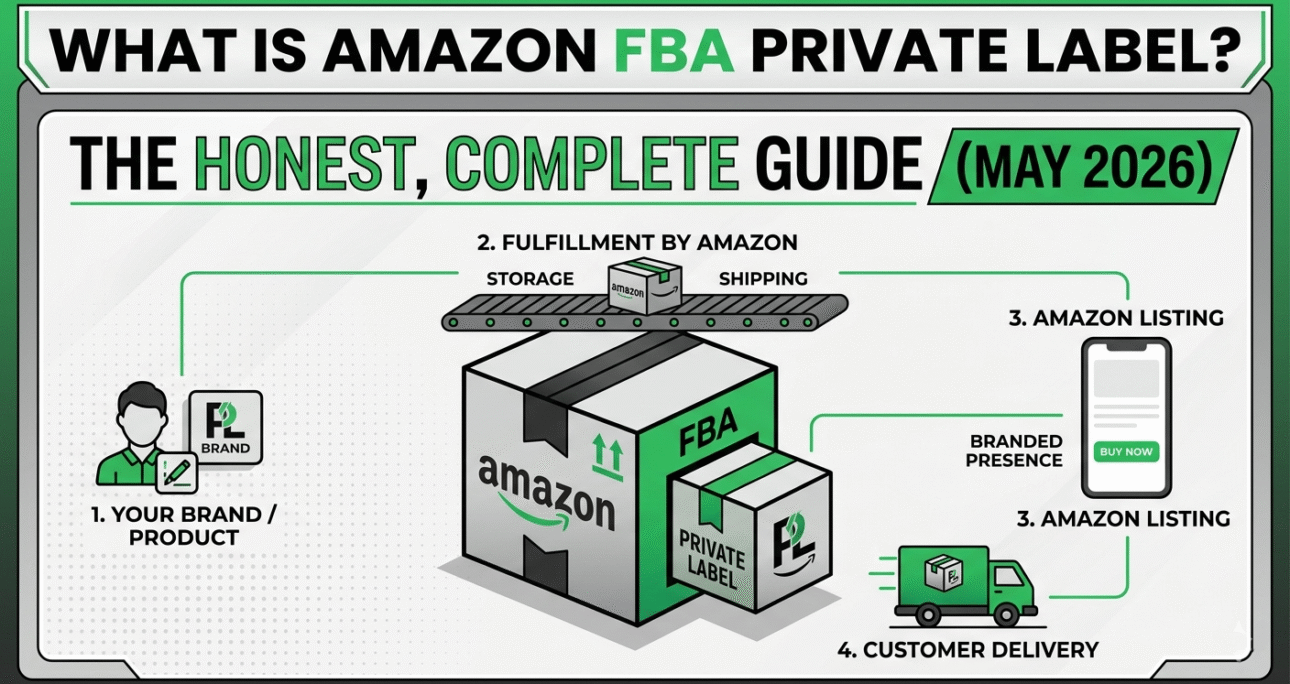
Amazon FBA private label involves sourcing a product, branding it as your own, and leveraging Amazon’s fulfillment network to handle logistics — a model widely used by modern sellers building long-term brands (as explained in this detailed guide).
Let’s Start From the Beginning
Amazon FBA Private Label is a business model where a seller sources a product from a manufacturer, brands it under their own company name, and sells it on Amazon using the Fulfillment by Amazon (FBA) programme — meaning Amazon handles all storage, packing, shipping, and customer service. The seller owns the brand and sets the price, while Amazon’s logistics network delivers the product to customers, often with Prime shipping.
It is the most popular selling model on Amazon, used by over 54% of sellers, and typically delivers net profit margins of 25–30%. Common steps include product research, finding a manufacturer (usually via Alibaba), creating branded packaging, and launching with Amazon PPC advertising.
Private label is not a new idea. Every time you’ve picked up a supermarket’s own-brand pasta or a pharmacy’s generic ibuprofen, you’ve used a private label product. A third-party manufacturer makes it. A brand puts their name on it and sells it as their own. The shopper buys the brand, not the factory.
On Amazon, sellers do the exact same thing — except instead of a supermarket shelf, your storefront is Amazon’s marketplace. You source a product (usually from a manufacturer in China, India, or domestically), brand it under your own company name, and list it for sale.
Now layer in FBA — Fulfillment by Amazon. Instead of storing products in your garage and driving to the post office every day, you ship your inventory to Amazon’s massive warehouses. When someone orders your product, Amazon picks it, packs it, ships it, and handles any customer service or returns. You pay Amazon fees for that service — but in return, your product carries the Prime badge, meaning it qualifies for next-day or two-day delivery for Amazon’s hundreds of millions of Prime members.
Put it all together: Amazon FBA private label means you own a brand, Amazon handles the logistics, and your product reaches customers at scale.
Simple definition: You source a product → brand it as your own → ship it to Amazon’s warehouse → Amazon stores, packs, and ships it → customers buy it with Prime shipping → you keep the profit after fees.
How Is This Different From Other Ways to Sell on Amazon?
A lot of newcomers confuse private label with other Amazon selling models. Here’s how they compare honestly:
| Model | Brand Ownership | Typical Net Margin | Buy Box Competition |
|---|---|---|---|
| Private Label | ✅ You own it | 25–30% | None — you’re the only seller |
| Wholesale | ❌ Someone else’s | 10–20% | Often fierce |
| Retail Arbitrage | ❌ Someone else’s | 5–15% | Very high |
| Dropshipping | ❌ Varies | 5–12% | High |
The defining advantage of private label is that you are the only seller on your listing. You automatically win the “Add to Cart” button on every sale. No one can undercut your price on your own product. In every other model, you’re competing with other sellers on identical listings — a race to the bottom on price that rarely ends well.
Why Do So Many Sellers Choose This Model?
You’re building something real. A private label brand is an asset. Done right, it can be sold. Brand aggregator firms have paid sellers seven figures for well-built private label businesses. You’re not just making sales — you’re accumulating equity.
Higher margins than any other model. Because you buy directly from manufacturers in volume, your cost of goods is low. Because you own the brand, you set the price. Private label sellers consistently achieve net margins of 25–30%, compared to 10–20% for wholesale and often less for arbitrage.
Complete listing control. You create the listing from scratch — photos, title, description, A+ Content. You decide how your product is positioned and what keywords it ranks for. Compare that to wholesale, where you’re just one of several sellers on a listing someone else created.
The Prime badge is a conversion machine. Many Amazon shoppers filter results to show only Prime-eligible items. FBA gets you that badge automatically. Without it, you’re invisible to a huge portion of Amazon’s most loyal buyers.
Hands-off fulfillment. Once your inventory is at Amazon’s fulfillment centers, you don’t touch it again. No packing boxes, no trips to the post office, no managing returns manually. Your job becomes marketing, inventory management, and product development — not logistics.
Real talk: The “hands-off” part is real — but only after launch. The first few months are very hands-on: research, supplier negotiation, listing optimization, and advertising all require active attention.
What Does It Actually Cost in 2026?
This is the section most guides get wrong, either by underselling the investment or inflating numbers to make it sound scarier. Here are honest, current figures.
Startup costs for one product:
| Cost | Realistic Range | Notes |
|---|---|---|
| Product samples | $50 – $300 | Order from 2–3 suppliers |
| Initial inventory (300–500 units) | $1,500 – $4,000 | Depends on product type |
| Sea freight to Amazon | $300 – $800 | Air freight is 3–4× more |
| Branding & logo | $100 – $500 | Fiverr, 99designs, freelancer |
| Product photography | $200 – $600 | Non-negotiable for conversions |
| Third-party inspection | $200 – $400 | Strongly recommended |
| Amazon Professional account | $39.99/month | Required at scale |
| PPC launch budget | $500 – $2,000 | Needed for initial sales velocity |
| 3PL prep fees (new in 2026) | $150 – $400 | Amazon eliminated its own prep service Jan 2026 |
| Total | $3,000 – $9,000 | For a solid, competitive launch |
2026 update: Amazon eliminated its FBA Prep and item labelling service effective January 1, 2026. You now need to prep your inventory yourself or use a third-party logistics (3PL) provider before shipping to Amazon. Budget $150–$400 extra per shipment for this.
Ongoing Amazon fees per sale:
- Referral fee: 8–15% of sale price (most categories sit at 15%)
- FBA fulfillment fee: ~$3.22–$6.50+ per unit, based on size and weight
- Monthly storage: $0.87–$2.40 per cubic foot (spikes 2–3× in Q4)
- Aged inventory surcharge: kicks in at 181+ days in Amazon warehouses
- Low-inventory fee: introduced in 2025, penalizes sellers who run too lean on stock
- 2026 fee increase: average +$0.08 per unit, effective January 15, 2026
In total, Amazon’s fees typically consume 25–40% of your selling price before you account for cost of goods or advertising. Products in the $45–$85 price range with a landed cost of goods under $12–15 per unit are where the math tends to work well. Products priced below $30 face brutal margin compression at the current fee structure.
Profit formula: Net Profit = Revenue – COGS – Amazon Fees – Shipping – PPC – Returns – Overhead. Target a net margin above 20%. Below 8% is not sustainable.
How to Start: A Step-by-Step Overview
Step 1 — Product Research Find a product with consistent demand, a price between $30–$70, fewer than 500 reviews on the top 10 competitors, and clear room for improvement based on existing customer complaints. Tools like Helium 10 or Jungle Scout help validate this with real data before you commit a dollar.
Step 2 — Find and Vet a Manufacturer Search Alibaba for your product and request quotes from at least 5–10 suppliers. Order samples from your top 2–3. Always use a third-party inspection service like QIMA or V-Trust before releasing final payment on a bulk order. Inspections cost $200–$400 and can save you from an entire ruined shipment reaching Amazon.
Step 3 — Build Your Brand Create a business name, logo, and packaging design. File for a trademark (or use Amazon’s IP Accelerator service). Once your trademark is registered, enroll in Amazon Brand Registry — it unlocks A+ Content, brand storefronts, and stronger listing protections against hijackers.
Step 4 — Create Your Amazon Listing Your listing is your storefront. Invest in it. Minimum five high-quality photos (main image on white background, lifestyle shots, infographics). A keyword-optimized title. Five benefit-driven bullet points. A compelling A+ Content section using secondary keywords throughout.
Step 5 — Ship Inventory to Amazon Prep your inventory to Amazon’s guidelines using a 3PL provider (remember: Amazon’s in-house prep ended January 2026). Create an inbound shipment in Seller Central and ship to the assigned fulfillment center.
Step 6 — Launch With Advertising Start Amazon PPC (Sponsored Products) campaigns on day one. Run a launch coupon to drive initial conversion velocity. Enroll in Amazon Vine to generate early reviews. Track your ACoS, conversion rate, and click-through rate weekly and adjust bids accordingly.
Step 7 — Manage, Reorder, and Scale Watch your sell-through rate closely and reorder before you stock out — stockouts tank your ranking and momentum fast. Once a product is profitable, expand: new variations, complementary products, new marketplaces. This is when private label becomes a real brand, not just a listing.
Is Amazon FBA Private Label Still Worth It in 2026?
This is the question every honest guide has to answer directly. The landscape has changed meaningfully since 2016–2020. Here’s the unvarnished picture.
What’s working:
- Highest net margins of any Amazon selling model (25–30%)
- Over 300 million active Amazon customers
- More than 30,000 FBA sellers earned over $1 million in annual sales in 2026
- Health, home, and eco-friendly niches remain underserved in many sub-categories
- Brands can be sold for 2–4× annual profit to aggregators and buyers
Real challenges:
- FBA fees increased again in 2026 (+$0.08/unit average)
- PPC advertising now costs roughly 15% of revenue for page-one placement in competitive categories
- Amazon’s own house brands compete in many popular niches
- Amazon eliminated its FBA Prep service in January 2026
- Around 20% of new sellers exit the marketplace within their first year
- Policy changes arrive constantly and require ongoing attention
The honest conclusion: private label is still one of the best e-commerce business models available — but the floor for entry has risen. The sellers who succeed in 2026 are those who differentiate genuinely (not just slap a logo on a generic product), understand their unit economics deeply before ordering inventory, and plan for a 12-month runway, not a 30-day payoff.
Most new private label sellers don’t see their first truly profitable month until month 4–7. Anyone promising profit in 30 days is selling a course, not experience.
The bottom line: If you have $5,000–$10,000 to invest, genuine patience, and a product idea grounded in real market data — Amazon FBA private label remains one of the most reliable paths to building a sellable brand online. If you’re expecting quick returns or have under $3,000, wait until you do.
Common Mistakes That Sink New Sellers
Choosing a product based on passion, not data. Your enthusiasm for a niche doesn’t matter if the market numbers don’t support it. Validate first, always.
Skipping the inspection. One defective bulk shipment — already paid for, already shipped to Amazon — can wipe out months of profit and damage your seller metrics. A $300 inspection is the cheapest insurance you’ll ever buy.
Over-ordering inventory. Aged inventory fees are a quiet, persistent killer. Start with 60–90 days of projected sales, not 12 months’ worth. You can always reorder; you can’t un-pay storage fees on 800 units sitting still.
Ignoring unit economics before launch. Run your real numbers through Amazon’s FBA Revenue Calculator before placing any supplier order. Know your break-even price, target margin, and worst-case scenario.
Entering an oversaturated niche. If all top 10 results have 3,000+ reviews and are sold by established brands, you need a genuinely differentiated product or a very large advertising budget. Neither is impossible — just go in with eyes open.
Frequently Asked Questions
What is Amazon FBA Private Label in simple terms? It’s a business model where you brand a product under your own company name, ship it to Amazon’s warehouses, and Amazon handles storing, packing, and shipping it to customers. You own the brand and collect the profits after Amazon’s fees.
How much money do I need to start? A realistic minimum is around $3,000 for a lean launch. A more competitive launch with professional photography, solid branding, and an advertising budget typically falls between $5,000 and $9,000 for a single product.
How long does it take to launch a product? Most sellers take 3–5 months from initial research to the first sale — accounting for manufacturing (4–6 weeks) and sea freight shipping (4–6 weeks).
Do I need a trademark to sell private label on Amazon? No — you can sell without one. But registering a trademark lets you enroll in Amazon Brand Registry, which gives you A+ Content access, brand storefront tools, and much stronger protection against listing hijackers. It’s strongly recommended.
What’s the difference between FBA and FBM? With FBA, Amazon stores your inventory and handles shipping and customer service. With FBM (Fulfillment by Merchant), you manage all of that yourself. Most private label sellers choose FBA because the Prime badge significantly boosts conversion rates.
Where do sellers source private label products? Most start with Alibaba.com, which connects you with thousands of manufacturers primarily in China. Some use professional sourcing agents for help navigating supplier relationships. Domestic sourcing is possible but typically carries higher costs.
Final Thoughts
Amazon FBA private label is not a passive income shortcut. It’s a real business model that requires real capital, real patience, and a genuine commitment to building something people want to buy.
The sellers who win in 2026 are the ones who treat it that way — who research before they invest, who differentiate instead of copy, and who understand that building a brand takes months, not weeks.
If you’re willing to do it right, the opportunity is still very much there. Amazon’s marketplace is bigger than it has ever been. The question is whether you’re building something worth a piece of it.
Last updated: May 2026. Covers Amazon FBA fees and policies current as of Q2 2026.
Rohaan is an e-commerce seller and writer with 5+ years of experience building brands on Amazon. All content is independently researched and reflects current platform policies.
Need Help Getting Started?
If reading this has you ready to act but unsure where to begin, working with a specialist agency can cut months off your learning curve. Ecom Mate is a UK-based e-commerce agency that handles Amazon Private Label end-to-end — from product research and supplier sourcing to listing optimisation and brand launch. They’ve helped sellers across the US, UK, and UAE scale to six-figure revenues, with a 72% average increase in monthly sales across managed brands. If you’d rather have experienced hands guiding the process than figure it all out alone, it’s worth exploring what they offer.
If you want to learn about Amazon’s 2026 FBA Surcharges, than you can go to our detailed blog.

Fair, unusually honest guide. The bit most people under-plan is the exit ramp: private label margins look fine until a slow-moving SKU starts accruing long-term storage, and by then the cash is already in Amazon’s warehouse. That is the main reason we see brands keep part of their stock at a 3PL and send smaller, more frequent replenishments instead of one big FBA shipment – you keep the option to liquidate or bundle without paying to get your own inventory back.