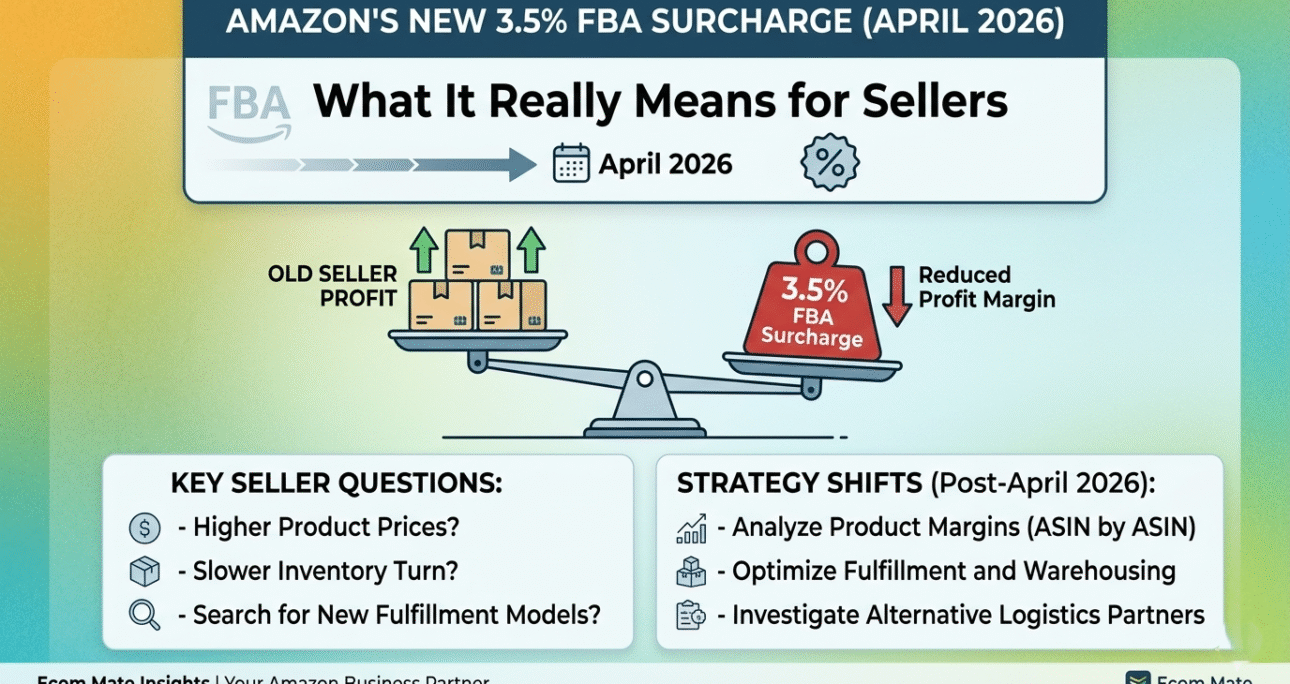
📌 Quick fba surcharge Update (April 2026)
- 3.5% surcharge on FBA fulfillment fees
- Starts: April 17, 2026
- Expands to MCF & Buy with Prime: May 2, 2026
- Average impact: ~$0.17 per unit
This isn’t a small update.
It’s a margin shift.
The Announcement (What Actually Happened)
Amazon has officially introduced a 3.5% fuel and logistics surcharge on fulfillment fees across its network.
This applies to:
- Fulfillment by Amazon (FBA) in the US & Canada
- Remote Fulfillment (US → Canada, Mexico, Brazil)
- Buy with Prime (starting May 2)
- Multi-Channel Fulfillment (MCF) (starting May 2)
The key detail most sellers miss:
👉 This surcharge is applied to fulfillment fees, not your product price.
On average, that’s about $0.17 per unit—but it varies depending on size and weight.
📰 Latest News Coverage

Amazon tells sellers it’s adding a 3.5% charge to offset rising fuel and logistics costs
Amazon to slap a 3.5% surcharge on third-party sellers as Iran war drives up fuel prices
Amazon to Boost Fuel Surcharges on Third-Party Sellers as Costs Rise
Amazon to Apply 3.5% Fuel Surcharge to Third-Party Sellers
Why Amazon Is Doing This (And Why It Matters)
Amazon’s official reasoning is straightforward:
Rising fuel and logistics costs across the industry.
And that’s not just PR language.
Fuel prices have surged significantly in 2026 due to global supply disruptions, especially tied to geopolitical tensions affecting oil routes.
Amazon had been absorbing these costs—until now.
Like other major carriers (UPS, FedEx, USPS), they’re now passing part of that cost downstream to sellers.
🧠 The Bigger Insight Most Sellers Are Missing
This isn’t about $0.17.
It’s about direction.
Amazon is shifting toward:
👉 More dynamic, variable cost structures
Instead of:
- Fixed fees
- Predictable margins
We’re moving into:
- Surcharges
- Adjustments based on global conditions
- Less cost stability
💸 What This Actually Means for Your Business
Let’s make this real.
If you’re doing:
- 10,000 units/month
👉 That’s roughly $1,700 extra per month in costs
That’s:
- $20,000+ annually
- Straight out of your margin
And here’s the catch:
👉 This stacks on top of:
- PPC costs
- Storage fees
- Returns
- Existing FBA increases
⚠️ Why This Hits Some Sellers Harder Than Others
Not all sellers feel this equally.
🔴 Most affected:
- Low-margin products
- Heavy or bulky items
- Highly competitive niches
🟢 Less affected:
- Premium brands
- High-margin products
- Strongly differentiated listings
📊 The Hidden Impact: Margin Compression
This is where most sellers underestimate the effect.
Let’s say your margin is:
👉 20%
A 3.5% increase in fulfillment cost doesn’t reduce your margin slightly.
It compresses it significantly.
Because:
- Fees are fixed
- Competition limits price increases
- Ads already eat margin
👉 Result:
Your profit shrinks faster than you expect.
🤔 Can You Just Increase Prices?
In theory, yes.
In practice?
It’s not that simple.
Because:
- Buy Box competition
- Price sensitivity
- Category pressure
Raising prices blindly can:
- Kill conversion
- Drop rankings
- Lose Buy Box
🚀 What Smart Sellers Will Do Now
This is where the gap widens.
1. Recalculate Unit Economics (Immediately)
Your old numbers are outdated.
Update:
- Net margin
- Break-even ACoS
- Pricing thresholds
2. Optimize Packaging
Small changes matter more now.
- Reduce weight
- Reduce dimensions
- Drop size tiers
👉 Sometimes this alone offsets the surcharge.
3. Improve Conversion Rate
Higher conversion = lower ad dependency.
Focus on:
- Images
- Listing copy
- A+ content
4. Cut Waste in PPC
Now is not the time for sloppy ads.
- Kill non-converting keywords
- Focus on profitable campaigns
- Tighten targeting
5. Strengthen Branding
This is where winners separate.
Strong brands:
- Handle price increases better
- Maintain conversion
- Reduce reliance on ads
⚠️ The Mistake Most Sellers Will Make
They’ll treat this like a “small fee.”
It’s not.
It’s part of a pattern.
Amazon has already introduced:
- Storage fee changes
- Inventory rules
- Advertising shifts
This is another step toward:
👉 Higher operational pressure on sellers
🧠 The Real Shift (Read This Carefully)
Amazon is no longer just a marketplace.
It’s becoming:
👉 A fully optimized logistics + margin system
Where:
- Efficiency wins
- Weak operators get squeezed
- Strong systems scale
💬 Final Thought (No Sugarcoating)
This surcharge isn’t going to “kill” your business.
But it will expose it.
If your margins are weak:
👉 You’ll feel it immediately.
If your systems are strong:
👉 You’ll adapt and move forward.
🚀 Want to Protect Your Margins Before It Hits?
Most sellers won’t react until profits drop.
Smart sellers adjust before that happens.
If you want a clear breakdown of how this surcharge impacts your product margins—and where you’re leaking profit—Ecom Mate can help you identify and fix those gaps before they compound.
👉 Explore how we work here:
https://ecommate.co.uk/